


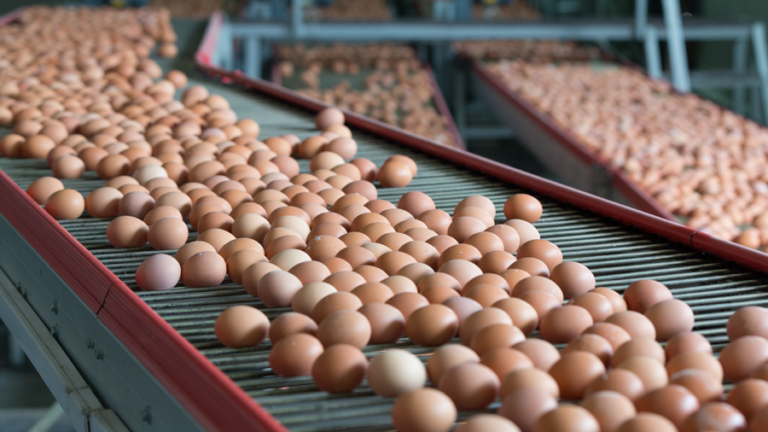
Boosting egg numbers with improvements in eggshell quality all life long
Eggs, a fundamental product in human diets worldwide, provide a convenient and essential source of nutrients for people everywhere. They are one of the most affordable sources of animal protein and are often hailed as nature’s complete food. Remarkably rich in high-quality amino acids, eggs boast a wealth of near-pure protein content.
Egg consumption is on the rise globally due to increased recognition of their nutritional benefits. In the EU, per capita egg consumption is projected to grow by 0.7% from 2019-2030. The latest FAO data show that world egg production reached 100 million tonnes in 2024, of which 94% was hen eggs. Asia produced 65.7 million tonnes, approximately 65.7% of the global total, while the European Union (27) produced 6.62 million tonnes, approximately 6.6% of the global total. (Source: FAO, Agricultural production statistics 2010 to 2024; FAOSTAT data visualized by Our World in Data.)
With its unique structural properties, the eggshell offers a natural and convenient packaging for the transportation of the egg contents. However, from a biological standpoint, the avian eggshell’s design primarily serves to safeguard the chick embryo during its development. This protective function commences with the cuticle, a protective layer that envelops the outer surface of the shell. Similarly, the egg-white antimicrobial peptides are specifically designed to ensure the safety and wellbeing of the developing embryo. These properties extend their protective benefits to those who consume the eggs.
The nutrition, age of the flock, health, and microbiological status of hens, along with egg collection, handling, washing, and packaging, directly impact both the external (eggshell) and internal properties of the eggs influencing the risk of egg contamination and potential foodborne outbreaks for consumers.
Trace mineral nutrition represents an opportunity to enhance eggshell quality during the entire production cycle, particularly as the hen ages. Achieving this goal necessitates understanding how trace minerals influence the long-term health of the hen and the organs involved in egg production, as well as recognizing the significance of minerals at various stages of the egg-forming process.
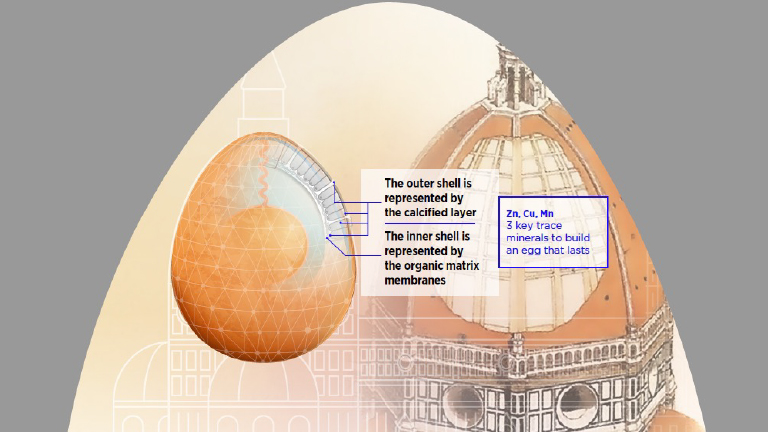
Like a well-constructed building meant to withstand the test of time, the eggshell comprises “bricks” (calcium carbonate) and “cement” (organic matrix). Zinc (Zn) plays a crucial role as a key supplier of carbonate (bricks), while the organic matrix is created through a finely regulated interaction of zinc (Zn), copper (Cu), and manganese (Mn). This process results in the formation of glycosaminoglycans, collagen fibres, and crosslinking (cement) found in the eggshell membranes, as well as proteins within the calcified eggshell matrix.
Therefore, Zn, Cu, and Mn are the three most crucial trace minerals for constructing a resilient egg structure.
Zinpro Zn boost eggshell quality by enhancing carbonic anhydrase activity in the plasma and eggshell gland of aged layers (2017, Poultry Science 96:2176-2183):
- +14.5% and +7.7% carbonic anhydrase activity in the plasma and eggshell gland tissue respectively of 67-week-old hens. This Zn dependent enzyme is important for eggshell calcification as it catalyzes the hydration of CO2 to HCO3− (carbonate) which is then pumped into the lumen of the shell gland along with calcium ions.
- Zinpro® Mn improved antioxidant response of hens at young and older stages of egg production
- +58% superoxide dismutase activity in the plasma of hens at 46 weeks of age
- +21% superoxide dismutase activity in the shell grand of hens at 92 weeks
- Zinpro Mn supported expression of genes encoding for proteoglycan, glycoproteins and calcium binding proteins in the shell gland of 66-week-old hens. Increasing the expression of such genes leads to greater mammillary knob density during the initial stages of eggshell formation and thus improving eggshell quality (2018 Poult Science 97(4)1253:1262)
- Zinpro Zn and Mn decreased the incidence of Salmonella Enteritidis content in the reproductive tract of 60-week-old hens
Foodborne pathogens, particularly nontyphoidal Salmonella, can establish themselves as part of the normal microbiota in hens. These potentially harmful microorganisms reside in the gastrointestinal tract of hens and can gain easier access to internal organs when birds have weakened epithelial integrity and lower immunity. The presence of high internal loads of Salmonella poses a significant challenge, as these bacteria can be transmitted through the hen´s egg to consumers, and potentially causing foodborne illnesses in humans.
The essence of a strong foundation leads to achieving increased performance and producing robust eggshells.
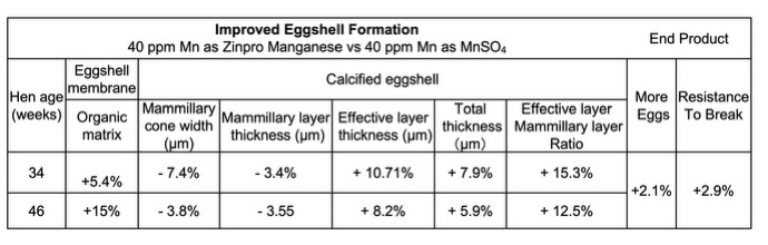
In a notable study, 45-week-old Hy-Line Brown layers, that were fed Zinpro Mn (40 mg Mn/kg feed) for 25 weeks demonstrated the highest egg production, with an increase of +2.1%, compared to hens fed 40mg Mn/kg of feed in the form of Mn sulphate. These eggs displayed enhanced organic matrix content in both the membrane and calcified eggshell, resulting in improved eggshell ultrastructure and greater breaking strength (as depicted in the picture below).
Egg breakage has long been an economic burden for the egg industry, accounting for approximately 8% of total egg production that requires downgrading. As hens age, this percentage can escalate significantly.
However, investing in Zinc and Manganese from Zinpro®Performance Minerals® can lead to substantial reduction in cracked eggs, thereby increasing the number of saleable eggs.
Feeding Zinpro Performance Minerals to commercial Hisex White layers proved to be highly beneficial. It resulted in the improvement in egg resistance to breakage, with increases of +6.2%, +3.1% and +4.1% as hen aged from 76 to 80 and 88 weeks, respectively. Additionally, the incidence of broken eggs decreased, showing a remarkable 73% reduction.
Under research conditions, providing Zn and Mn from Zinpro Performance Minerals to White Leghorn hens from 73 to 85 weeks yielded improvements in eggshell quality. The study demonstrated a reduction of 6.1% on the incidence of cracked eggs when hens were supplemented with 40 ppm Zn and 40 ppm Mn from Zinpro Performance Minerals instead of 60 ppm Zn and 70 ppm Mn from oxide forms. Furthermore, when hens were fed with 40 ppm Zn and 40 ppm Mn from Zinpro Performance Minerals, along with 20 ppm Zn and 30 ppm Mn from oxide form, there was a significant 9 % decrease in cracked eggs.
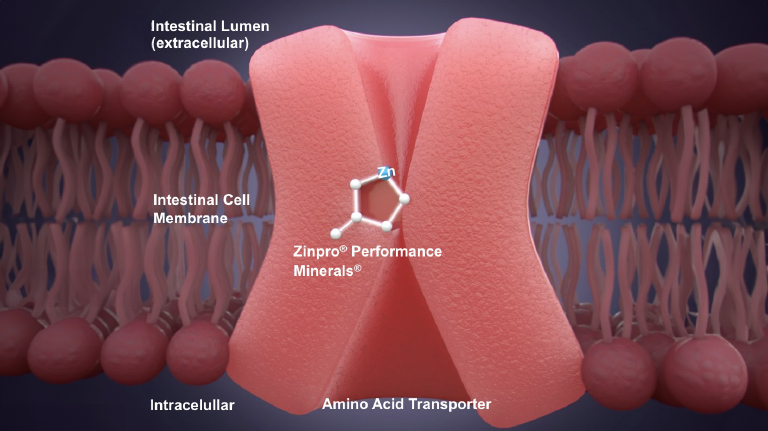
With the increasing demand for egg consumption and the layer industry moves towards higher welfare standards, maintaining high performance becomes crucial for a successful operation. The goal to deliver stronger hens and higher quality eggs can be realized through the use of Zinpro Performance Minerals, as they have been proven to address the major factors that can impact layer health and productivity. By integrating these advanced mineral supplements into their nutrition programme, poultry producers can enhance overall performance and meet the evolving demands of the market and consumers.
Learn more about how Zinpro can help unlock greater potential for your layers and eggs.