


Poultry News
  • Production
    • Broiler Production
    • Ducks
    • Egg Production
    • Game
    • Hatching
    • Housing
    • Turkeys
  • Processing
  • Business & Politics
    • Business
    • Economics
    • EU & Politics
    • Marketing
    • People
    • Training & Education
  • Welfare
    • Environment
    • Food Safety
    • Vet & Medication
    • Welfare
  • Feed
  • Genetics
  • New Products
  • Magazines
    • June 2026
    • 2026 Innovation Supplement
    • 2026 British Pig & Poultry Fair guide
    • May 2026
    • March 2026
    • 2026 Feed & Nutrition supplement
    • February 2026
    • January 2026
    • December 2025
    • November 2025
    • October 2025
    • September 2025
    • 2025 Buildings supplement
    • August 2025
    • 2025 Poultry Health supplement
    • July 2025
    • 2025 National Egg and Poultry Awards finalists supplement
    • June 2025
    • 2025 Innovation supplement
    • May 2025
    • April 2025
    • March 2025
    • 2025 Feed and Nutrition supplement
    • February 2025
    • January 2025
    • December 2024
    • November 2024
    • October 2024
    • September 2024
    • 2024 Building for the Future supplement
    • August 2024
    • 2024 Poultry Health supplement
    • July 2024
    • 2024 National Egg and Poultry Awards finalists supplement
    • June 2024
    • 2024 Innovation supplement
    • Pig & Poultry Fair 2024
    • May 2024
    • April 2024
    • March 2024
    • February 2024
    • January 2024
    • December 2023
    • November 2023
    • Processing Equipment Supplement – Nov 2023
    • October 2023
    • Building Supplement – Sept 2023
    • September 2023
  • Jobs
    • Browse Jobs
    • Post a Job
    • Manage Jobs
  • Events
    • National Egg and Poultry Awards
    • Poultry Fair
    • Webinars
Twitter LinkedIn
  • FREE Email Newsletters
  • About Us
  • Advertise
  • Subscribe
  • Contact Us
Twitter LinkedIn
Podcast
Poultry News
  • Production
    • Broiler Production
    • Ducks
    • Egg Production
    • Game
    • Hatching
    • Housing
    • Turkeys
  • Processing
  • Business & Politics
    • Business
    • Economics
    • EU & Politics
    • Marketing
    • People
    • Training & Education
  • Welfare
    • Environment
    • Food Safety
    • Vet & Medication
    • Welfare
  • Feed
  • Genetics
  • New Products
  • Magazines
    1. June 2026
    2. 2026 Innovation Supplement
    3. 2026 British Pig & Poultry Fair guide
    4. May 2026
    5. March 2026
    6. 2026 Feed & Nutrition supplement
    7. February 2026
    8. January 2026
    9. December 2025
    10. November 2025
    11. October 2025
    12. September 2025
    13. 2025 Buildings supplement
    14. August 2025
    15. 2025 Poultry Health supplement
    16. July 2025
    17. 2025 National Egg and Poultry Awards finalists supplement
    18. June 2025
    19. 2025 Innovation supplement
    20. May 2025
    21. April 2025
    22. March 2025
    23. 2025 Feed and Nutrition supplement
    24. February 2025
    25. January 2025
    26. December 2024
    27. November 2024
    28. October 2024
    29. September 2024
    30. 2024 Building for the Future supplement
    31. August 2024
    32. 2024 Poultry Health supplement
    33. July 2024
    34. 2024 National Egg and Poultry Awards finalists supplement
    35. June 2024
    36. 2024 Innovation supplement
    37. Pig & Poultry Fair 2024
    38. May 2024
    39. April 2024
    40. March 2024
    41. February 2024
    42. January 2024
    43. December 2023
    44. November 2023
    45. Processing Equipment Supplement – Nov 2023
    46. October 2023
    47. Building Supplement – Sept 2023
    48. September 2023
    Featured

    Poultry Business – June 2026 issue out now

    By Chloe RyanJune 8, 2026
    Recent

    Poultry Business – June 2026 issue out now

    June 8, 2026

    2026 Innovation Supplement out now

    June 8, 2026

    2026 British Pig & Poultry Fair guide out now

    May 13, 2026
  • Jobs
    • Browse Jobs
    • Post a Job
    • Manage Jobs
  • Events
    • National Egg and Poultry Awards
    • Poultry Fair
    • Webinars
Twitter LinkedIn
Poultry News
Production

Gender sorting: A strategic lever for UK poultry producers

Chloe RyanBy Chloe RyanJune 22, 20264 Mins Read
Facebook Twitter LinkedIn Email
Share
Facebook Twitter LinkedIn Email

This article first appeared in the innovation supplement to Poultry Business, published in June 2026

The UK poultry sector is operating in an increasingly complex environment – balancing rising demand for chicken meat, pressure on labour availability, and the need for more sustainable production systems. Within this context, gender sorting at hatchery level is emerging as a critical technology to improve efficiency, predictability and resource utilisation across the value chain.

Broiler gender sorting is a global trend

Across the global poultry industry, gender sorting is gaining momentum as producers seek to optimise performance and address structural challenges. Demand for poultry meat continues to increase, placing pressure on the industry to improve efficiency at every stage of production. Today, it is estimated that more than 25% of global broiler production already involves some level of gender sorting.

Traditionally, the identification of male and female day-old chicks has relied on manual feather-sexing techniques. While widely used, this process is highly labour-dependent and inherently variable. Accuracy depends on operator skill, fatigue and training level, and in practice it is common to see gender sorting accuracy drop to around 85% over time.

Industry experts now recognise automated gender sorting as a key technological advancement, enabling more consistent performance while supporting the broader transformation of poultry production towards greater efficiency and sustainability. As a result, gender sorting is no longer a niche practice but is progressively becoming a standard component of modern hatchery operations worldwide.

More meat with the same resources

One of the most significant advantages of gender sorting lies in its ability to improve resource efficiency throughout the production chain.

Male and female broilers have different growth rates, body composition and nutritional requirements. In mixed flocks, producers must apply a single feeding programme, which inevitably leads to females being overfed and males underfed. This imbalance limits overall performance and increases inefficiencies.

By separating sexes at hatch, producers can implement gender-specific nutrition and management programmes tailored to each group’s needs. This allows for improved growth rates, better feed conversion ratios (FCR), and reduced nutrient waste.

Gender sorting also plays a key role in improving flock uniformity—an essential requirement for modern processing plants. More uniform flocks result in better processing performance, fewer downgrades and improved yield consistency. This is particularly relevant in the UK market, where retailers demand tight carcass weight specifications and portion uniformity.

When male and female birds are reared separately and managed according to their biological potential, differentiated target weights can be achieved more efficiently. In practice, gender-sorted flocks can deliver between 2% and 8% more meat per square metre compared with as-hatched flocks, while also improving liveability and production consistency.

Genesys enables industrial-scale gender sorting

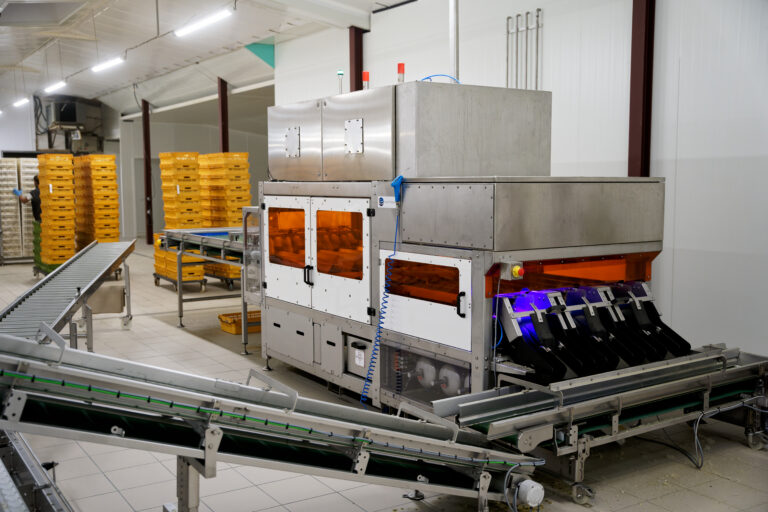
While the benefits of gender sorting are well established, large-scale implementation has historically been constrained by labour availability and process limitations. This is where automated systems such as Ceva’s Genesys represent a step-change for hatchery operations.

Manual sorting capacity is typically limited to around 2,500 chicks per hour per operator and requires large teams in high-capacity hatcheries. In the context of ongoing labour shortages in UK agriculture, maintaining such operations is increasingly challenging.

Genesys addresses these constraints by automating gender sorting through advanced imaging technology and algorithm-based identification. The system delivers consistent accuracy levels above 97%, significantly reducing the variability associated with manual processes.

Designed for modern hatchery environments, Genesys combines high throughput with a compact, modular footprint, allowing easy integration into existing chick processing layouts. Its scalable design makes it particularly well suited to high-volume hatcheries, sorting 50,000 broiler chicks per hour per module.

By replacing a labour-intensive and variable process with a standardised, high-performance system, Genesys allows hatcheries to maintain throughput, improve consistency and reduce dependence on skilled labour—an important advantage in today’s operating environment.

For UK poultry producers, gender sorting is rapidly evolving from an optional practice into a strategic necessity. Faced with increasing demand, labour constraints and sustainability expectations, the industry must continue to improve efficiency without expanding resource use.

Automated gender sorting technologies provide a practical and scalable solution to these challenges. By enabling more precise resource utilisation and supporting industrial-scale hatchery operations, systems such as Genesys are helping to modernise poultry production.

In a competitive and demanding market, adopting such innovations will be key to maintaining performance, meeting customer expectations and ensuring the long-term sustainability of UK poultry production.


Share. Facebook Twitter LinkedIn Email
Previous ArticleWhy white birds are gaining ground in modern egg systems
Chloe Ryan

Editor of Poultry Business, Chloe has spent the past decade writing about the food industry from farming, through manufacturing, retail and foodservice. When not working, dog walking and reading biographies are her favourite hobbies.

Read Similar Stories

Egg Production

Why white birds are gaining ground in modern egg systems

June 22, 20262 Mins Read
Production

Free-Range poultry growers wanted across East Anglia

June 19, 20264 Mins Read
Production

Hatching a plan for turkey

June 12, 202611 Mins Read
Latest News

Gender sorting: A strategic lever for UK poultry producers

June 22, 2026

Why white birds are gaining ground in modern egg systems

June 22, 2026

Free-Range poultry growers wanted across East Anglia

June 19, 2026
Sponsored Content

Take Control of Your Farm’s Biosecurity with Livetec

May 1, 2026

Address beta-mannans in broiler diets to optimise bird health and performance

April 1, 2026
© 2024 MA Agriculture Ltd, a Mark Allen Group company

Privacy Policy | Cookies Policy | Terms & Conditions

  • Farmers Weekly
  • AA Farmer
  • Farm Contractor
  • Pig World

Type above and press Enter to search. Press Esc to cancel.