


As producers continue to navigate a difficult energy environment, Michael Barker asks what’s in store in 2026 and how technology can help
The debilitating energy cost increases seen in the aftermath of Russia’s invasion of Ukraine may now be in the rear view mirror, but high prices continue to drain poultry producers’ bottom lines and periods of relief have been fleeting.
Farm energy prices peaked in 2022-23, and although they began to stabilise and even fall in late 2024 and 2025, they remain significantly higher than in 2019. With producers all looking to lower their carbon footprints and become more efficient, experts say that good energy management and the adoption of modern technologies has become absolutely vital.
It feels like whenever there’s been good news on energy in recent times, bad news has never been far behind. “The current cost is variable,” says Will Raw, chair of the NFU Poultry Board. “Depending on when you tied into electricity contracts and for how long, it can have a huge effect on how much you are paying. This makes planning incredibly difficult, and producers are not on a level playing field. Geopolitics and world trade play such a huge factor in getting timings right, and it’s become a bit of a lottery.”
NFU Energy’s senior energy consultant Roger Stones says poultry farmers can expect electricity bill increases in 2026 not as a result of electricity unit price increases, but because of a hike in non-negotiable fixed standing charges. Energy regulator Ofgem recently approved a 63% increase in fixed transmission grid charges (Transmission Network Use of System Charges), with the goal of generating the income to allow grid operators to repair and upgrade the UK’s ageing transmission infrastructure.
While other areas of farming – in particular energy-intensive operations such as commercial glasshouses – will be more heavily affected, it’s still an unwanted extra hit on poultry producers’ bill. Unless exempt in some way, NFU Energy data indicates that the average broiler farmer can expect to pay some £9,300 more per year – a 55.2% increase – while egg producers may pay as much as £32,000 more – a 72.4% rise.
The NFU has taken up the industry’s case, with director general Terry Jones recently writing to minister for industry Chris McDonald to called on the government to remove energy costs as a barrier to growth, and similar lobbying has been directed towards Ofgem.
It all underlines the importance of incorporating technology that brings the maximum possible efficiency to poultry units. According to NFU Energy, poultry farms use mostly electricity, diesel and gas for energy. However, many farms benefit from biomass-based heat supported by the historic renewable heat incentive (RHI), and feed-in tariff (FIT)-supported solar PV systems.
Renewables, and solar in particular, are a big focus area for producers, with Raw estimating that around a third of poultry farmers already have some form of renewable energy on site. His own farm has invested in solar panels and biomass, as well as looking at battery storage options.
Poultry sheds are typically blessed with big roof areas ideal for solar PV generation. Many new poultry shed designs include solar PV readiness, better insulation, optimised ventilation and heat recovery to reduce heat losses and excess heat gains in summer.
Thermal and electrical energy storage are time-honoured ways to optimise renewable energy or leverage cheaper time-of-use tariffs, notes Stones. However, he advises that producers should approach battery storage with caution, as its viability varies from farm to farm.
Thermal efficiency is an important consideration in managing energy requirements. “Whilst nothing will replace a good stockman walking the sheds and sensing the atmosphere, embracing automation within the heating and ventilation system can help maintain optimum performance by reducing environmental fluctuations,” explains Ben McGill, sales director at Vencomatic Poultry UK. “Employing poultry house management systems such as the Hotraco Fortica allows producers to balance heat energy introduction, heat exchanger activation, and air recirculation to create an optimum environment for the birds.”

Stones believes that the increasing cost of electricity is likely to push poultry farming towards gas for its bulk energy requirements, and renewable-supplemented grid electricity for the remaining energy needs. “Decarbonising the gas grid with local and national AD biogas infrastructure seems logical because it is achievable with existing infrastructure, such as gas-to-grid sewerage, recycling and landfill,” he says.
Successful energy management depends on good energy use data, he adds, advising producers to first understand how energy moves through their farm, a process he says is surprisingly easy with inexpensive half-hour energy loggers. “Insist on accurate energy billing from your suppliers and track your monthly energy use and costs,” he suggests.
While there isn’t currently any specific funding to upgrade energy equipment, some councils occasionally offer ad-hoc support. The ADOPT fund supports farmer-led collaborative projects to test innovative on-farm solutions, and NFU Energy also administers the Climate Change Agreement (CCA), where eligible poultry producers can benefit from a tax discount through energy savings.
It should be noted that chicken litter has a higher energy density than some animal wastes like dairy slurry. However, Stones points out that it’s not easy to consistently generate energy from chicken litter-based anaerobic digestion systems, and that research and support is needed before farmers head down that path.
“We see some interest in chicken litter gasification,” he adds. “Gasification is a high temperature thermochemical process that produces renewable gas from chicken waste in an oxygen-starved process. Gasification reduces the waste volume by 80-90% while producing biochar or biochar-based fertiliser.”
Volatility in the energy markets has certainly led to businesses looking at becoming more resilient, according to Raw. “Within our business we are running a combination of older and newer sheds – the older sheds have all been refurbished to reduce heat loss,” he says. “Projects have included reinsulating cavity walls, insulating external block work and, in the more extreme cases, replacing and reinsulating shed roofs. Alongside these measures we also have heat recovery units on sheds. It’s a case of anything we can do to drive down input costs.”
Raw also talks up the potential of hydrogen. “I attended an energy conference last year at Askham Bryan College where one of the speakers was talking about the use of hydrogen fuel,” he recalls. “They felt there was scope for poultry farms to produce their own hydrogen on site using electrolysis of water. The energy made using solar or other renewables could split the hydrogen out of water, then the hydrogen could be used to heat the poultry units.”
Lighting is another area that could bring savings, and it can even play a role beyond simply illuminating a space. Indeed, the best new technologies can stimulate animal behaviour, maintain a stable and healthy farm climate, and of course impact energy use. Hato highlights updates to it Corax and Pulsa range, which offer more precise dimming in the low range and improved energy performance, with smoother transitions supporting animal comfort and reduced stress. Some models also now include UVA light, bringing lighting close to natural daylight and offering more control over the environment.
Smart controls and AI will also be expected to become increasingly important, with computers microanalysing climatic and environmental conditions to ensure maximum efficiency and cost savings.
While new technologies will undoubtedly play a leading role, Vencomatic Poultry UK’s sales executive Tony Grainger stresses that making the most of the energy already produced should remain the foundation. Installing heat exchange units, which can deliver over 80% thermal efficiency, ensures that poultry producers can maximise the value of the heat they have already paid for by using it to warm incoming air, he points out. This also improves the birds’ environment, potentially leading to better FCR, improved bird health and fertility, fewer floor eggs for breeders, and reduced feed costs for layers, as the birds’ energy requirement decreases in response to an improved climate.

The battle for energy efficiency will continue, and producers will look expectantly to see what new weapons and techniques will be added to their arsenal.
ECO Units and the push to net zero
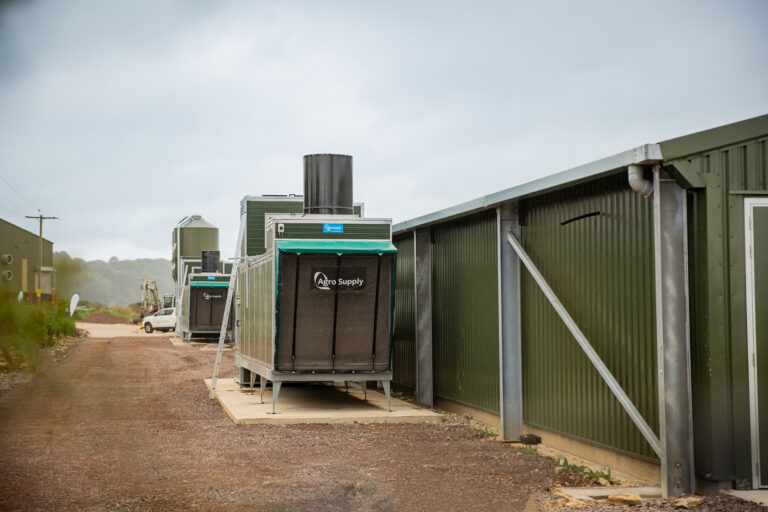
Vencomatic’s ECO (Environment and Climate Optimisation) units are designed to address modern energy challenges, and range from simple minimum ventilation heat recovery systems with thermal efficiency of up to 80%, to full climate control through ECO Zero for maximum ventilation.
One case study with Pilgrim’s Europe Moy Park highlights the savings possible. Designed and constructed as “the farm of the future” for Moy Park, Beech Farm in Lincolnshire’s year-long build was completed in 2023. The farm was created to set new benchmarks for sustainable and cost-effective chicken production, and was the first in the UK to achieve a 100% reduction in energy-related greenhouse gas emissions, leading the way in eco-friendly farming practices.
The farm employs various technologies, including ground-source heat pumps for heating, ECO Units to minimise overall heat consumption, and solar technology.
ECO Units are described as an ideal solution for minimum ventilation in poultry houses, particularly during the colder months. They create a superior environment, enhance litter quality, and deliver significant energy savings.
The units’ heat exchangers warm fresh air from outside using the warm air extracted from inside the poultry house, according to Vencomatic. Their design means producers can maintain a perfect and consistent climate within the house, resulting in optimal litter quality and reduced ammonia emissions.
The heat exchangers also offer impressive thermal efficiency of up to 80%, and the preheated air is efficiently distributed through the Louvre system. This technology is managed by intelligent software and is said to bring substantial savings in heating costs and a reduction in CO2 emissions.