


Poultry News
  • Production
    • Broiler Production
    • Ducks
    • Egg Production
    • Game
    • Hatching
    • Housing
    • Turkeys
  • Processing
  • Business & Politics
    • Business
    • Economics
    • EU & Politics
    • Marketing
    • People
    • Training & Education
  • Welfare
    • Environment
    • Food Safety
    • Vet & Medication
    • Welfare
  • Feed
  • Genetics
  • New Products
  • Magazines
    • December 2025
    • November 2025
    • October 2025
    • September 2025
    • 2025 Buildings supplement
    • August 2025
    • 2025 Poultry Health supplement
    • July 2025
    • 2025 National Egg and Poultry Awards finalists supplement
    • June 2025
    • 2025 Innovation supplement
    • May 2025
    • April 2025
    • March 2025
    • 2025 Feed and Nutrition supplement
    • February 2025
    • January 2025
    • December 2024
    • November 2024
    • October 2024
    • September 2024
    • 2024 Building for the Future supplement
    • August 2024
    • 2024 Poultry Health supplement
    • July 2024
    • 2024 National Egg and Poultry Awards finalists supplement
    • June 2024
    • 2024 Innovation supplement
    • Pig & Poultry Fair 2024
    • May 2024
    • April 2024
    • March 2024
    • February 2024
    • January 2024
    • December 2023
    • November 2023
    • Processing Equipment Supplement – Nov 2023
    • October 2023
    • Building Supplement – Sept 2023
    • September 2023
  • Jobs
    • Browse Jobs
    • Post a Job
    • Manage Jobs
  • Events
    • National Egg and Poultry Awards
    • Poultry Fair
    • Webinars
Twitter LinkedIn
  • FREE Email Newsletters
  • About Us
  • Advertise
  • Subscribe
  • Contact Us
Twitter LinkedIn
Podcast
Poultry News
  • Production
    • Broiler Production
    • Ducks
    • Egg Production
    • Game
    • Hatching
    • Housing
    • Turkeys
  • Processing
  • Business & Politics
    • Business
    • Economics
    • EU & Politics
    • Marketing
    • People
    • Training & Education
  • Welfare
    • Environment
    • Food Safety
    • Vet & Medication
    • Welfare
  • Feed
  • Genetics
  • New Products
  • Magazines
    1. December 2025
    2. November 2025
    3. October 2025
    4. September 2025
    5. 2025 Buildings supplement
    6. August 2025
    7. 2025 Poultry Health supplement
    8. July 2025
    9. 2025 National Egg and Poultry Awards finalists supplement
    10. June 2025
    11. 2025 Innovation supplement
    12. May 2025
    13. April 2025
    14. March 2025
    15. 2025 Feed and Nutrition supplement
    16. February 2025
    17. January 2025
    18. December 2024
    19. November 2024
    20. October 2024
    21. September 2024
    22. 2024 Building for the Future supplement
    23. August 2024
    24. 2024 Poultry Health supplement
    25. July 2024
    26. 2024 National Egg and Poultry Awards finalists supplement
    27. June 2024
    28. 2024 Innovation supplement
    29. Pig & Poultry Fair 2024
    30. May 2024
    31. April 2024
    32. March 2024
    33. February 2024
    34. January 2024
    35. December 2023
    36. November 2023
    37. Processing Equipment Supplement – Nov 2023
    38. October 2023
    39. Building Supplement – Sept 2023
    40. September 2023
    Featured

    Poultry Business – December 2025 issue out now

    By Chloe RyanDecember 8, 2025
    Recent

    Poultry Business – December 2025 issue out now

    December 8, 2025

    Poultry Business – November 2025 issue out now

    November 9, 2025

    Poultry Business – October 2025 issue out now

    October 13, 2025
  • Jobs
    • Browse Jobs
    • Post a Job
    • Manage Jobs
  • Events
    • National Egg and Poultry Awards
    • Poultry Fair
    • Webinars
Twitter LinkedIn
Poultry News
Housing

Feeding solutions for the 21st century

Chloe RyanBy Chloe RyanSeptember 9, 20224 Mins Read
Facebook Twitter LinkedIn Email
Share
Facebook Twitter LinkedIn Email

The design of poultry houses has changed very little over the years, but there are now more options for feeding and drinking equipment than ever before

In just over 30 years, Dalton Engineering has become one of the UK’s main agricultural suppliers and installers. It was one of the first UK companies to supply and install suspended feeding and drinking equipment and is now UK agent for VDL Agrotech, Vostermans and Microfan. Very little has changed in this period from an installation perspective, according to the company. Wooden posted houses, for example are still built with trusses at 10ft centres.

Keeping it level

All Dalton troughs and drinkers are made in 10ft (3.048m) lengths: this keeps systems level, as the suspension points are always directly under a truss. With a European three metre trough, the 48mm loss at each suspension point soon results in the trough ending up mid bay, making it difficult to keep level. Exposed wooden trusses also offer great installation flexibility. It’s no problem moving equipment 50mm laterally, as there is the whole truss available.

While steel-framed houses have their advantages greater planning and design time is required with the house builders. Positions of the feeders and drinkers must be accurately specified in order to hit the 200mm x 50mm undersection timber at installation.

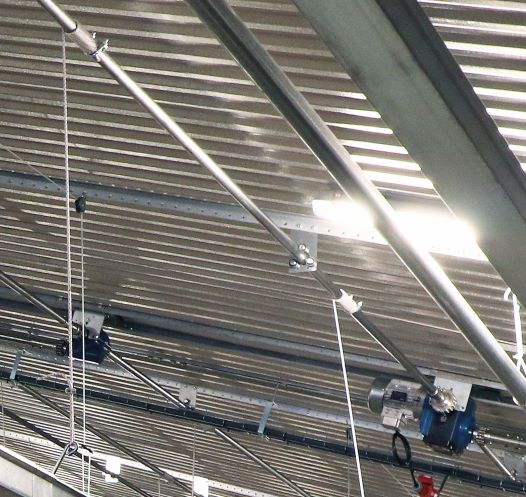
Repositioning at installation requires removal of roof sheets to install noggins at 10ft centres or making steel brackets to span across the purlins. Raising and lowering of feeding equipment has traditionally been done by electric or manual winch. The main ‘pulling’ cable is usually 5mm galvanised wire, with a 3mm drop wire at each suspension point. The drop wire is then located over a pulley and tagged onto the main cable. The winch is anchored to the building and draws the main cable around a winch drum or tube, lifting the equipment. The ‘centre loop’ of cable should be checked daily by farm staff for signs of wear and tear. This cable does all the lifting work and Dalton recommends changing the centre loops after every 1,500 daily cycles.

To winch or not to winch?

Some breeder houses have the feed systems designed to be winched every day. There are two main purposes to this. The first is so feed can be distributed whilst raised, then lowered to ensure all birds get fed simultaneously. This stops birds chasing the feed around the house. Secondly, when daily feeding has finished the system is wound back up, leaving the floor area clear for mating activities.

Alternatively, breeders sometimes now opt to keep feeders at working height during the flock, only winching up at turnaround. This has improved safety implications and feed is distributed faster using inverter controlled
fast drives. This can result in feeders running with a chain speed of 39m per minute, with two hoppers per circuit, halving the feed time. The height of the trough allows for the birds to pass underneath.

A superior and safer alternative to both these options is the VDL tube winching system. This allows the clear floor space of the traditional daily winching, but is far safer. A tube is positioned the full length of the house; this is rotated by the winch instead of a main pulling cable. Only the individual drop wires, generally a re-enforced typtoline cord, are wrapped on to the tube. The advantage is that if one drop wire snaps, then the rest of the system should stay suspended. If the traditional main pulling cable snaps, at least half the feeder line will drop to the floor.

Weight loading

When considering suspended chain feeder installation, weight loading of the house is vitally important. In a breeder house with trough, excluder grill, feed and feed chain, the combined equipment weight can soon reach five or six tonnes. Pullet rearing requires multiple feed circuits to achieve the required feed space. With the added weight of birds on suspended tables, raised perching and above the feeders and drinkers, weight loading can be colossal. If half of the birds in a 16,000 bird-rearing house perch on roof-suspended equipment, the increase in load could be around 10 tonnes, plus up to 3 to 4 tonnes of the other
equipment.

Whist it is accepted that this weight is distributed reasonably evenly, it still very important to consider all weight loading. Some older cage houses, re-purposed for other types of birds, generally weren’t built to have suspended feeding systems, and as such have little structurally integrity and limited insulation.

Share. Facebook Twitter LinkedIn Email
Previous ArticleMoy Park announces plans to close Ashbourne processing plant
Next Article New labelling rules for EU imports delayed until 2024
Chloe Ryan

Editor of Poultry Business, Chloe has spent the past decade writing about the food industry from farming, through manufacturing, retail and foodservice. When not working, dog walking and reading biographies are her favourite hobbies.

Read Similar Stories

Egg Production

Comment: Egg consumption is higher than ever

December 12, 20254 Mins Read
Broiler Production

Comment: Keep on top of your litter this winter

December 11, 20253 Mins Read
Broiler Production

Attention to detail drives success on Lancashire broiler farm

December 10, 20254 Mins Read
Latest News

Introducing Will Raw, new NFU poultry board chair

December 12, 2025

Comment: Egg consumption is higher than ever

December 12, 2025

Comment: Keep on top of your litter this winter

December 11, 2025
Sponsored Content

Stay one step ahead of outbreaks

December 3, 2025

Can Aviance improve production and shell quality in full laying cycle?

October 1, 2025
© 2024 MA Agriculture Ltd, a Mark Allen Group company

Privacy Policy | Cookies Policy | Terms & Conditions

  • Farmers Weekly
  • AA Farmer
  • Farm Contractor
  • Pig World

Type above and press Enter to search. Press Esc to cancel.