

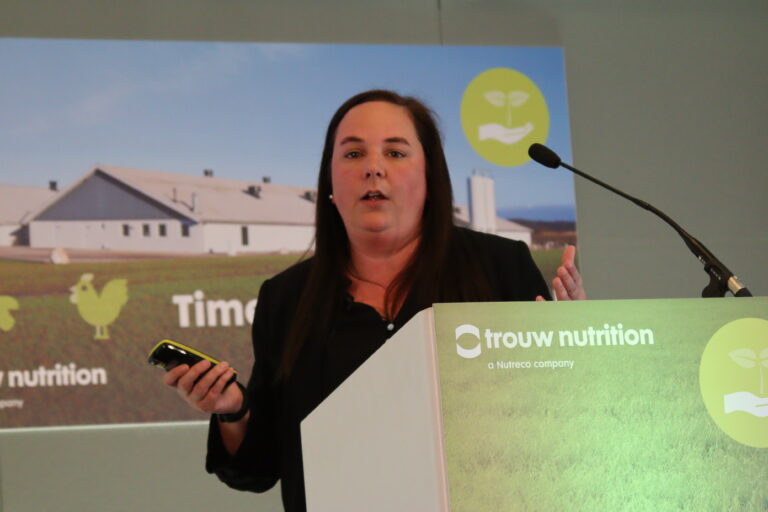
If the poultry sector is going to meet the targets of a 30% reduction in emissions by 2030, and net zero by 2050 then it will be essential to change the narrative surrounding emission reduction. This was the key message to delegates at the recent Time to Take Control event hosted by Trouw Nutrition.
“Sustainability is about meeting the needs of the present without compromising the ability of future generations to meet their own needs,” explained NFU Poultry Advisor Aimee Mahony.
“To develop a more sustainable industry we must balance the three pillars of sustainability, namely environmental, economic and social sustainability. We need to appreciate that not everyone individually will be able to meet net zero targets but collectively the industry can.
“We must also never shy away from talking about profit. If businesses are not making money they will not be successful or sustainable. But by focussing on on-farm efficiencies it will be possible to deliver economic and environmental sustainability, as more efficient business will cut emissions while improving returns.”
Mahony stressed the need for metrics that can drive reductions, commenting that the industry needs to ensure that the huge quantities of data produced are fully utilised to identify opportunities to improve.
She suggested that there are big opportunities in renewables, battery storage although this is currently cost prohibitive and manure use, seeing this as a benefit and not a waste product. She conceded that for many farms the starting point for emission reduction will be feeding.
With feed accounting for around 80% of the cost of poultry production, both layers and broilers, and also contributing around 80% of industry emissions, there is a great opportunity to improve ingredient sourcing and efficiency of diet utilisation.
Poultry producer George Roach carried out a Nuffield Scholarship looking at the potential for insect protein. He explained that insect protein could replace some soya and has a superior amino acid profile. However, there are some significant challenges that will impact how quickly and how significantly producers could change to insect protein.
“The first challenge is regulatory, specifically around the types of substrate that insects can be fed. We need insects to be cleared to be fed any substrate,” he said.
“The second challenge is scalability. At present the UK broiler industry uses around 1.2 million tonnes of soya a year. The global production of insect protein is less than 220,000 tonnes per year and some big producers are closing down which will hit supply.
“Finally, prices are currently very high which will affect how attractive it will be to many producers looking to balance economic and environmental sustainability.”
Sofie Kilroy, Trouw Nutrition sustainability manager stressed the need for whole industry participation in emission reduction. She explained that while 74% of poultry meat emissions are generated during broiler production, around 24% are generated post farm in slaughter, processing and retail.
She also commented that as poultry meat is consumed as a range of products, it can make carbon footprint calculations complex.
“To make sustained progress it is essential that the entire supply chain engages in helping to identify the opportunities and implement solutions.”
Summarising the conference, Dr Liz Homer from Trouw Nutrition reiterated that the cost of emission reduction and the additional value created must be shared across the supply chain.
“Everyone can contribute to meeting the targets, The more who engage, the faster progress will be made and sharing value will be key to making this happen.
“Underpinning industry change will be data, the collection of which has to stop being seen as a burden. It is only by improving the interpretation the data collected across the supply chain that decision making will improve, allowing progress against the three pillars of sustainability and the maximum value to be realised from reducing the carbon footprint of poultry products.”