

FarmGate Hatcheries is in rarefied air as a UK turkey hatchery, and as Michael Barker finds out, the business is thriving thanks to its premium, in-demand products
The turkey-hatching business has contracted and consolidated so much over the years that being one of the last ones standing is almost an achievement in itself.
But simply surviving is not in the mentality of Essex-based FarmGate Hatcheries, which has grown and thrived as a premium operator to the extent that it was crowned Hatchery of the Year at the 2025 National Egg & Poultry Awards, beating off some heavyweight chicken hatchers in the process.
A part of the famous Kelly turkey-production stable, FarmGate started life back in 1971 under the name Kelly Hatcheries with the aim of breeding and hatching slower-growing white turkeys. Supplying the traditional trade, local farmers and butchers, it acted as a small independent factory that was far removed from the integrated business that it is today.
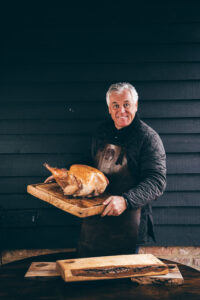
Current managing director Paul Kelly came into the business in 1984, when there were 13 independent hatcheries in the country all selling turkey poults – a huge amount more than the two remaining today. “There’s two factors in that. One is that the number of turkeys produced by independents has dropped dramatically – we [as an industry] were producing 38 million, and now it’s 11 million – and that’s because of cheap imports and cheap chicken,” Kelly explains. “Whereas turkey used to compete with chicken on price 30 years ago, it doesn’t any more. So it’s more of a niche rather than a mainstream protein.”
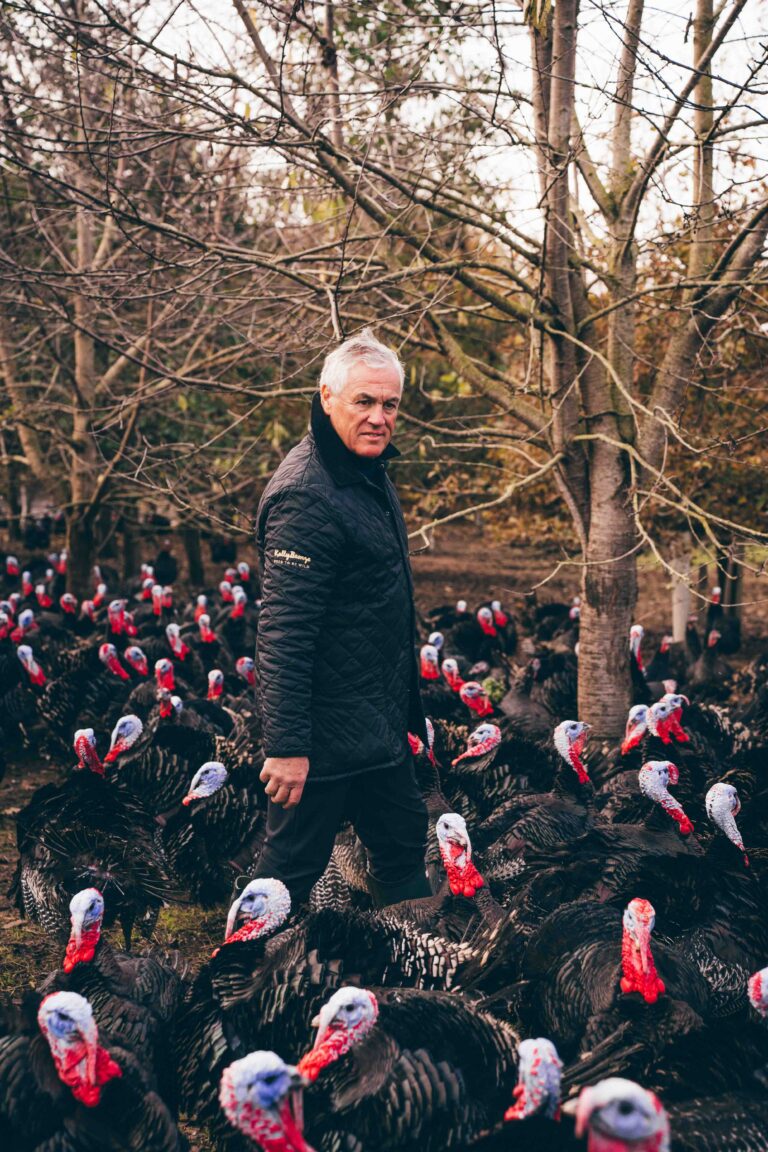
As other hatcheries went out of business, FarmGate picked up the slack and grew its own production. Kelly Turkeys, of course, are associated with the premium-quality end of the market, with the famous KellyBronze bird described as the “Rolls-Royce of turkeys”, and as its Bronze business took over in the 1980s, the company went on to pick up several stricken competitors and further grew through consolidation. Moving forwards, as the company gained new customers it was able to invest in a new hatchery in the early 90s and build a further one next to it in 2008.
Today, the company produces 12 commercial breeds, and has 23 pure lines in its gene pool. It hatches 1.8 million poults, but only keeps 140,000 of them within the Kelly business, with the rest going out to farmers of all sizes across the country.
A specialist operation focused on breeds for Christmas – Kelly has a 30% share of the seasonal turkey market – FarmGate is only open for around 14 weeks of the year and thus has to deal with the numerous challenges of seasonality. “It’s like a combine harvester – it’s a huge asset and only works for a few weeks of the year,” Kelly points out.
Good staff at the heart
There’s a full-time staff base of 72, with a further 60 people brought in at Christmas, and for those employees that are there year round, it’s a case of being jacks-of-all-trades. “A big part of our job description is that our hatchery manager, for example, is our butchery manager at Christmas,” Kelly says. “So we all have to be multi-skilled. First and foremost we are farmers. So I could be doing some TV and having a meeting with the bank manager in the morning, and mucking out turkeys in the afternoon. It’s very hands on.”
While that’s a lot to juggle, Kelly agrees that it makes for an interesting life. It also, though, means staff training is important, and recruiting people with a can-do attitude and willingness to be flexible is essential. “If you like a job where you turn up at eight in the morning and do the same thing till five at night, week in week out, we are not the business for you,” he adds. “What you’re doing in January will be radically different to what you’re doing in July, and different again to what you’re doing in November. Whatever we have to do on the farm gets done.”
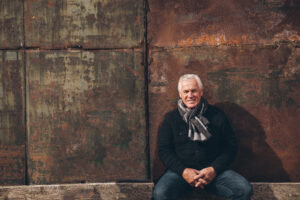
When you can count on one hand the number of turkey hatchers in the country, it goes without saying that recruitment isn’t easy. There’s not exactly a conveyor belt of young, well-trained hatchery managers coming along, and that means Kelly has to look for different qualities in his recruits, with a view to bringing them in and training them up in-house. A positive attitude is arguably the most important characteristic: “There’s no college anywhere that does incubation as a course,” he says. “There is in America, but not here. So getting good staff is hard, especially for a seasonal hatchery. We’ve got a great team at the moment, but as a team we’re also all getting older.”
Kelly was delighted when FarmGate collected the award ahead of some of the big chicken hatcheries, and he puts it down to a fluid combination of traditional and modern production techniques combined with good planning and high-quality staff. “It’s about skill, dedication, loyalty and working as a team,” he explains.
The company has made a significant investment over the past few years in upgrading both the hatchery and processing plant, with new hatchers designed to ensure high poultry quality over the next two decades. The difficulty with a seasonal business, however, is trying to get payback on big capital spends when you’re only using the equipment for 12 weeks a year, meaning it simply doesn’t make financial sense to attempt to automate every single operation.
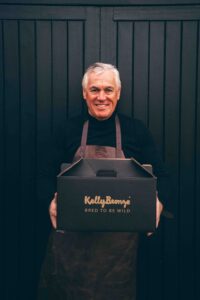
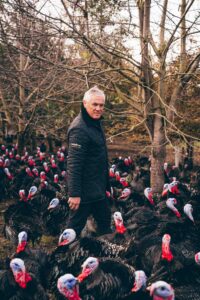
Kelly also wisely put up a significant amount of solar seven years ago, which has insulated the company from the worst of the energy price rises seen since the outbreak of the Ukraine war and now the conflict in the Middle East. That’s also boosted the farm’s overall sustainability credentials, adding to initiatives such as doing more wild woodland turkeys and reducing stocking birds per acres in woodlands and free range. “You haven’t got to go through the carbon-burning stuff of putting sheds up and concrete down and electric in,” he says. “We’re de-intensifying what we’re already doing, making it more extensive.”
So how has the business changed over the years that’s Kelly’s been at the coal face? “Twenty years ago if you’re using these breeds, if you’re weren’t hatching many it would be hard to supply customers,” he says. “If you have scale, you’ve got a bit of volume and can bank eggs for two or three days and it makes it much easier to supply the market. And everything has gone from what was multi-stage incubation, to now we’re 100% single-stage.”
FarmGate has one hatchery that is the company’s breeding grandparent and pure-line hatchery, and the other that is a commercial hatchery. That allows more continuity and disease freedom at a time when biosecurity is very high up all producers’ agendas.
Evolving the offer
Kelly has some big plans for the business. The company already has a small hatchery in Virginia in the US, with the goal of growing the branded product in the world’s largest consumer market. And in this country, the focus has been on developing charcuterie lines, in so doing expanding usage of turkey beyond Christmas. That includes products such as confit thighs, turkey hams, burgers and salamis under the Krafted by Kelly label. It’s part of a strategy to make use of the processing plant for more than three months, as well as building a bigger full-time staff for more of the year.
It’s also about the company fighting back against one of the great mysteries of the turkey market, namely why the product is so popular and ubiquitous in the US market all year round but still frustratingly restricted to the Christmas market in the UK. Kelly believes that much of the reason for that actually comes down to the simple factor of cooking information. “Cooking instructions for Thanksgiving turkeys in the US are very different,” he explains. “They brine them and they deep fry them – brining and deep frying is really good. If you brine a cheap, immature turkey it’s not that bad. Over here, people just roast turkey. If you roast a cheap, immature turkey, it’s bad, especially with the cooking times. So I think far too many people have had a bad experience of turkey at Christmas, whereas over there they haven’t had a really bad experience at Thanksgiving, and they are willing to try it all year round. We shot ourselves in the foot really with cooking instructions and producing turkey with no fat.”
With the new range of products, Kelly says he is excited by the potential in the turkey market – particularly as he insists the meat isn’t being seen as competing directly with chicken so much. “I think that’s a good thing, because for too long people thought ‘we can’t sell any turkey because it’s not as cheap as chicken’,” he points out. “But now the price difference is so much that it’s very obvious that for people who are buying turkey it’s not about price, but because they want to have it.”
As an industry, Kelly feels that there’s been a lack of innovation in terms of new product development, promotion and marketing, but there’s huge potential to grow the market on the back of its clear points of difference to chicken. Instead of going head to head with chicken, he believes the true competition should be with the likes of veal, salmon, fish and lamb.
Kelly laments the lack of support turkey has had from some of the multi-category suppliers, but believes the industry stands at a moment of real opportunity from the fact that 2026 represents the “500th year of turkey”. The industry is pulling together behind that message and viewing it as a unique chance to highlight turkey’s many benefits, while Kelly’s is helping educate its butcher customers in how to cut, promote and sell turkey and take back the market share that has been lost to imported breast meat from predominantly Italy, Germany and Poland.
The industry’s united campaign behind the 500th anniversary has already raised quite a bit of money, according to Kelly, and the marketing push is kicking off now with a view to hitting the mainstream hard in the autumn. “King Henry VIII put turkey on the map, so it’s the year to buy a whole turkey and we’ll teach you how to cook it, carve it and give you some great leftover recipes as well,” he says.
With such potential for growth, does that mean Kelly plans to expand the business? “We could sell an awful lot more turkeys,” he emphasises. “People are asking us for loads of it, but we just don’t have the farming space. I don’t want to be a commodity meat producer. We have a wonderful niche product, and that’s why all the growth is in charcuterie, because people want to buy KellyBronze and put it on the menu. The chef in the kitchen can destroy it. Turkey cooked well is delicious, but it’s not a very forgiving meat. So we can have a chef make turkey, put our name on it, and people think it’s not very nice. That’s why we are doing all of our [charcuterie] products ready to eat – we are in control of what it tastes like.”
Kelly’s enthusiasm for his craft knows no bounds, and that’s only reinforced by the fact that he recently completed his term as Master of the Worshipful Company of Poulters. “It was lovely,” he recalls. “The livery world in London is fantastic, and to experience that as a Master takes you to a different level. You get to meet some amazing people and see some amazing livery halls. It’s really wonderful.”
That experience also gave Kelly the chance to take the temperature of the whole poultry industry, and refreshingly, he describes the sector as “buoyant”. “For the first time in a long, long time, every single sector of the poultry market is making good profits.”
Kelly admits that situation is unusual and almost unsettling, but long may it continue.