

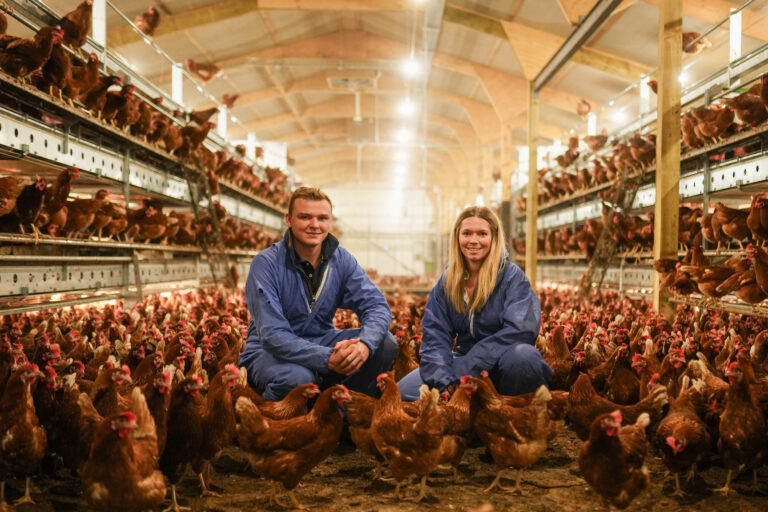
Still in his 20s, Callum James has already set up a successful egg-production business as he builds on his farming upbringing. Michael Barker reports
Not many young people can say they’ve started up a business in their first job, especially in the narrow-margin world of poultry farming.
Down in the idyllic surroundings of south-west England, however, Callum James has done precisely that, drawing on his experience of growing up on a layer farm to establish Devon & Somerset Eggs. So impressive has the venture been, that it earned James the Young Farmer of the Year trophy at this summer’s National Egg & Poultry Awards in London.
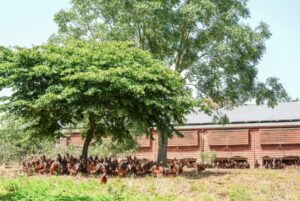
James’ upbringing more than hinted at his future endeavours, growing up as he did on his family’s farm on the Devon-Somerset border, where his father has kept free-range hens for more than three decades. After going off to Harper Adams to complete a degree in agriculture and spending time seeing the world, he returned in 2021 to take on the challenge of helping the family take the farm to the next level.
That strategy was to come through an expansion that has involved a somewhat painstaking journey through Britain’s planning system as the family business looked to extend what at the time was 16,000 birds across three sheds with the addition of a new 32,000-bird unit.
When he first returned from his studies, James actually started working for another farmer half an hour away, but as the fates would have it that farmer was looking to retire and it presented an unmissable opportunity for a young man looking to forge his own path. It led to James and his partner Anna Lampitt setting up Devon & Somerset Eggs three years ago, and it’s fair to say they haven’t looked back since. “They offered us a farm business tenancy there and we took that up as we still hadn’t been granted the planning permission for my own family’s site,” James recalls.
Straight in at the deep end, James and Lampitt took on responsibility for what was a 34,000-bird unit featuring timber-frame sheds and flat decks, and immediately set about expanding one of the largest sheds by taking out the flat-deck equipment and retrofitting a multi-tier system that took production up to 40,000 birds.
Across the two sites, there are now some 56,000 birds, and this year also brought the good news of that hard-fought planning permission being granted for expansion at the home farm, Goodalls, which is expected to be completed in February of next year. Goodalls Farm, which had to reduced down to 16,000 birds in two static sheds as part of the planning process, is selling through St Ewe, while the 40,000 new unit at Haddon Farm is packing for Fridays.
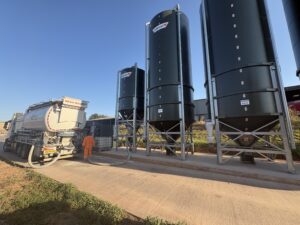
As part of its modern approach, Devon & Somerset Eggs has started home meal mixing, which James says has brought notable savings and good feed control, as well as helping to address the demand for sustainable, local feed production. “We moved over to Fridays earlier this year,” he explains. “In our previous contract we were limited in where we could get our feed from. Now we’ve put in five big feed bins, with all the raw materials, and once a week we have a mill mixer come in on a Monday and he makes up all our feed for the site. It’s been a good route to be going down. We use a company called Green Circle at Exeter, which is not very far away”
Farming was a natural path for James, given his background and studies. He spent some time digging potatoes in Australia and briefly considered the potential of moving into broilers, but free-range eggs seemed the logical route to take. “I’d always grown up with farming,” he recalls of his childhood. “Poultry was always there in the background, and I’d pick up eggs for pocket money. I did a level three diploma in agriculture before my degree. None of it was specifically poultry related, but I’d done a lot of tractor work and obviously got farming experience when I was younger, and that was the thing that really took my fancy and seemed to be the option when I got closer to the end of university.”
Now 29, it’s a good time for James to take stock of his career so far and the amount that he’s achieved by an age that many people are only just getting into second gear. That journey included completing the NFU’s Poultry Industry Programme (PIP) two years ago: “I thoroughly enjoyed that and it was great to see situations that I wouldn’t have got to see if I’d just stayed on the farm,” he enthuses. “It’s a great group of people and a great opportunity.” He also sits on the board of the West Country Layers’ Association and attends NFU poultry meetings, suggesting a bright future in industry affairs lies ahead.
Indeed, he points to the PIP as the perfect introduction for young people coming into the industry, and advocates for targeting job seekers, local colleges and other places where people might have an interest in agriculture to get more people involved. “When I was at college and university there wasn’t a massive amount of promotion about the poultry industry,” he recalls. “You quite often hear about sheep and beef, but poultry seems to get put to one side. It might not be everyone’s cup of tea, but people are always quite interested to hear about it. When we have open days and people come around, they are amazed.
“As an industry, you have to be quite careful with people not understanding about chickens and where meat comes from, but I think that comes down to a lack of education. There should be more possibilities out there for people to learn and take part. The industry quite often gets bad press on the poultry side, which isn’t very nice.”
Setting up a new business is one thing, but the biggest challenge that James has come across in his career to date has been his interactions with the planning regime, which meant it took the family five painful years to gain permission for the expansion on their home farm. “We don’t have the easiest of locations,” he admits. “We are an AONB (Area of Outstanding Natural Beauty) and have a SSSI (Site of Special Scientific Interest) only about four or five kilometres away from the site. It took us nearly five years to get planning permission and then another eight to ten months on the pre-commencements, which was very frustrating.”
The biggest sticking point came down to a face-off with Natural England over ammonia. “I can understand that in a lot of places they’ve got a threshold of 1%,” James continues. “We modelled our farm at current levels of 20,000 birds in a flatbed – I think we were emitting about 4.5% ammonia to the SSSI, and then we dug our heels in and said ‘with this new site we’re doubling the amount of birds and taking some old flat-deck units out of production’. And we remodelled it and we were about 1.3-1.4%, so we reduced it greatly but because we were still over this 1% threshold they wouldn’t accept it. We had to fit ammonia scrubbers to our unit at great expense just to get to that 1% point.”
James says he can understand the rules as long as everyone is on a level playing field across the country, but expresses frustration at the fact that planning seems to get waved through with barely a cursory glance in some counties while it’s meticulously scrutinised in others. “We’re only trying to reinvest in the future of our farm,” he says. “We’re not trying to conquer the world or anything, just reinvesting in an existing poultry farm. That was our biggest frustration. There’s a market need, and if we’re short of eggs or chicken as a country we should be able to invest in these sites.”
Aside from the planning regime, one other unexpected issue he faced in setting up the new business was convincing everyone that he was to be taken seriously. “I wouldn’t say it was a challenge as such, but it was quite interesting early on that as a younger person trying to start a new business there were a few comments like ‘is your dad around to speak to?’” he recalls. “It didn’t faze me as such, but it was slightly interesting.”
It’s fair to say such issues are firmly in the past, particularly given the experience James has gained in both setting up a new business and updating units with modern technologies. The converted sheds feature new technology like central controls, while a series of cameras have been fitted on the egg belts for the purposes of counting and identifying any issues. Back in the sheds, cameras are also helping monitor for any welfare issues with the goal of tackling any problems as soon as they arise. It’s still early days for using that technology, but James is excited by the potential it offers.
Furthermore, sustainability boxes are being ticked through the installation of solar panels, while the company is assessing the potential of putting battery storage into the new shed.
It’s all part of a continuous evolution at what is still a fledgling business, and that has included making sure there are enough bodies around to handle a growing workload. James admits that in the early days he and Lampitt tried to do everything themselves, but over time they have added some staff to balance out the workload. “We’ve got a good farm manager on site and generally a good team all around,” he says.
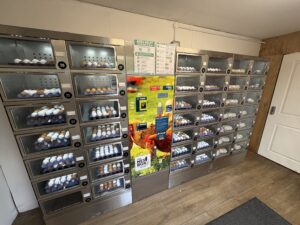
One of the interesting quirks of the farm is that it already had an egg-vending machine when James and Lampitt took it on. That’s proving a pleasingly fruitful endeavour with sales growing every week, and that in turn has inspired investment in two further machines that have been dotted around Somerset. “We’ve been really pushing that side of things and it seems to be quite a good option,” he says. “We put that in our contact that we can sell privately.”
Capitalising on that, the company has also set up a website to give consumers the opportunity to buy directly, tapping into shoppers’ desire for the freshest eggs by sending them out on the day of lay for orders put through by 2pm. An employee has even been hired to handle the social media promotion for that direct-to-consumer work as part of a plan to gradually promote that side of the business.
Amid the hard work of getting the business off the ground, James still finds time for a bit of clay pigeon shooting and the occasional ski trip, but admits that chicken and eggs is very much his full-time occupation. Winning the award was a “thrill”, he says, and he found the experience of attending the ceremony and seeing all the great work being carried out across the industry thoroughly inspiring.
For 2027, the focus is firmly on getting that long-awaited expansion completed. That’ll no doubt make for a very satisfying 30th birthday present as James looks to take the next steps on what is already proving a very accomplished career.