


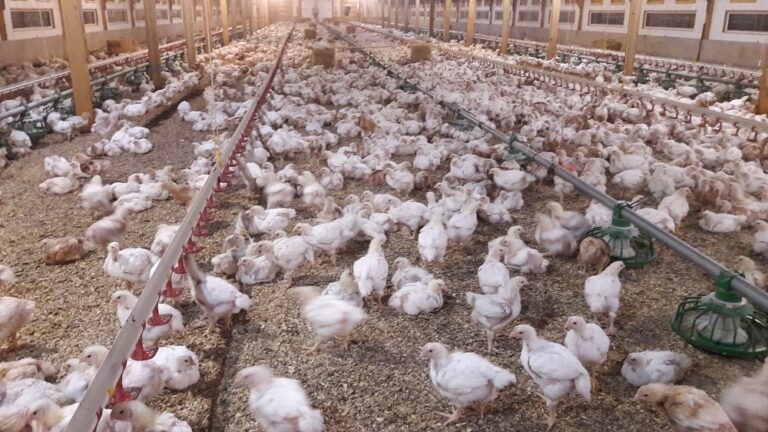
As more supermarkets move to 30kg/m2 stocking densities, the race is on to secure supplies in a strained marketplace. Michael Barker reports
Change is in the air in UK chicken supply, with a domino effect taking place as supermarkets take turns to announce new stocking density requirements.
The latest cabs off the rank are Tesco and Aldi, which both declared in the last month that their chicken will be grown with 20% more space than the industry standard. An ostensibly positive move for animal welfare, the sudden switch is, however, causing instability at the farmgate as their suppliers scramble to ensure they have enough meat produced to the new specifications.
Tesco made its announcement in mid-June, declaring that by the first half of 2025 all of its fresh chicken in its core ranges will be produced to a stocking density of 30kg/m2, compared to the industry standard of 38kg/m2 – the maximum allowed by Red Tractor.
The supermarket said the move builds on its existing higher-welfare brands, which already include lower stocking densities, and will ensure the birds will continue to have increased access to environmental enrichment such as straw bales, perches, pecking objects and natural light.
Tesco noted that it has already committed to an additional £12m in financial support for its British chicken farmers and suppliers over the course of 2024/25.
A fortnight after Tesco’s announcement, fourth-largest supermarket Aldi – which sources all of its fresh chicken from British farms – said that it too was transitioning to the same reduced stocking density by the end of 2024, giving its birds 20% more space than the industry standard. Like Tesco, Aldi pointed out that it has also committed to “significant multi-million pound financial support” for its chicken farmers and suppliers over the course of the next year.
It’s fair to say the move has gone down well with animal welfare groups – even if they still believe there’s much more to be done. An RSPCA spokesperson said the charity welcomed Tesco’s announcement, describing it as “an important step forward for animal welfare and will mean many more chickens have the space to move around and exhibit their natural behaviours.”
“Tesco has already made welfare improvements by ensuring chickens have continued access to enrichment and natural light – and we now hope they, and other retailers, go one step further and sign up to the Better Chicken Commitment,” a spokesperson said. “This would commit them to only using slower-growing, higher-welfare breeds of chickens.”
Following a trend
Whether that happens remains to be seen, but what the move does do is bring Tesco and Aldi into line with other leading supermarkets. Sainsbury’s was the first of the largest chains to switch to 30kg/m2 back in March 2023, while Morrisons, Co-op and Lidl committed to the same standard in the early months of this year. Waitrose also meets that standard, and has additionally signed up to the Better Chicken Commitment and pledged to sell chicken from slower-growing breeds by 2026.
That just leaves Asda of the big stores left. The retailer’s website states that all of its own-brand fresh chicken is 100% British and reared to the Red Tractor standard, which means maximum stocking densities of 38kg/m2. “All our chickens from our main chicken supplier are reared to high standards by British farmers, in large barns with natural light where they are free to roam around and engage in natural behaviours,” it states.
‘Bidding war’ for supplies
With Tesco, Morrisons and Aldi all in the process of switching over their stocking densities at once and at relatively short notice, at farm level it’s left something of a race to secure supplies.
One well-placed industry source, who asked not to be named, told Poultry Business that the move to 30kg/m2 has sparked “a bidding war” between the integrators, with broiler growers being offered more money per kilo as there is now a shortage of birds on the ground due to the lower stocking density. While some growers say they have “never had it so good”, integrators are understood to be extremely concerned about how to get the birds they need to fill their factories.
A second industry source, also speaking on condition of anonymity, similarly describes a somewhat chaotic “race for space” that contrasts unfavourably with the 2025 cage-free egg drive, which was a clear date that was brought in with years’ notice as something for the industry to work towards. “In the case of cage-free, all the retailers moved at the same time and they had several years to work it out, whereas now you’ve got various retailers jumping and deciding to go for it and the industry just having to react,” the source says. “So what you’ve got at the moment is different processors going around and trying to secure space and offering farmers sums of money – five pence, six pence per square meter more than they’re getting under their current agreements – and it’s creating quite a lot of friction between the processors and the farmers. They are basically approaching farmers and throwing money at them.”
The source says the poultry meat sector is one that has always prided itself on working in an open and fair way, with trust and respect to the fore and “not a lot of skullduggery” going on, but that is being put to the test in the current environment.
The supermarkets have made money available to help their suppliers facilitate the change to lower stocking densities as they would have been “well aware of the commercial implications” of their decisions, the source said – and he also expects the shelf price of chicken could rise as a result of producing less meat from the same amount of space.
The spotlight now moves to Asda as the last big retailer not to have moved. If it does, while it would create even further pressure on supply in the short term, there’s a feeling it might actually make things easier and more cost-effective going forward if everyone is working to the same standard. “If all of a sudden you have a proportion of your farms which are at 30kg, and then a proportion of your farms which are 34 or 35kg and some at 38kg, it almost makes the system unworkable,” the source says. “If you make a supply chain complicated, it injects cost into it, whereas if you can make everything really simple, and you can make everything the same and ultra flexible, you will get a lower cost out of the back end. So yes, people like Asda, I’m sure, will end up with 30kg chickens.”
An issue driven by consumers and pressure groups, the industry source noted that some people in the independent sector are saying the industry is “shooting itself in the foot and capitulating to the welfare lobby, and we’re almost kidding them about the welfare benefits that you’ll get”. Where the welfare groups go next will be interesting to see, but the RSPCA spokesperson stressed that they are calling for all supermarkets who haven’t yet signed up to the Better Chicken Commitment to do so.
One of the reasons the focus has been on stocking densities is that it is a concept that is easy for the general public to understand, the second source believes. “If you have a shed of Ross 308s and a shed of Hubbard Redbros, a general member of the public wouldn’t understand the difference between them, looking in a shed, whereas they do understand that there are fewer chickens in a square metre. If you look at what happened in the egg sector with the move from cage and the way consumers have embraced free range, they really get it and it’s a simple concept.”
The consumer picture very much makes sense. Now it is up to farmers and processors to make sense of how to make it all work.