


Poultry processing machinery is becoming ever-more advanced as manufacturers respond to growing demand for new formats. Michael Barker reports
The way Brits consume their poultry and eggs has evolved over the years, with the rise of smaller occupancy households and a growing desire for convenience products bringing with it a vast market for new formats.
That in turn is offering innovative suppliers a blank canvass to create products for every need state, and it’s been up to the equipment manufacturers to provide them with the tools to do the job in as efficient, cost-effective and safe manner possible.
According to a new report published this summer by Markets & Markets, the UK poultry processing equipment market is currently valued at $163.1m, and is expected to surge to $283.2mn in the next five years as a reflection of the industry’s commitment to modernisation and automation, alongside ever-tighter food safety regulations.
That strong growth is also a sign of the positive future that lies ahead for the egg and poultry meat sectors generally, given the continued demand for tasty, convenient, protein-rich products. From the processors’ point of view, labour cost pressures are further tipping the scales in favour of making the spend on machinery worthwhile. “The UK market benefits from a mature supply chain and significant capital investment from both domestic and international equipment manufacturers,” the report explains. “Between 2026 and 2031, the UK is expected to see accelerated adoption of integrated processing systems, hygiene-focused equipment, and digital monitoring solutions.”
Leighton Banner, branch manager for FAM STUMABO UK & Ireland, says poultry processors face growing demand for a wider range of convenient, value-added formats – often from the same production facility. Diced chicken for ready meals and pizzas, strips for wraps and salads, and sliced fillets for sandwiches remain important applications, he says, while there is also interest in pulled-look and shredded chicken for bowls, fillings and ready-to-eat meals. “The challenge is handling these different formats at industrial volumes while meeting tight specifications,” he continues. “As product ranges diversify, processors increasingly need production setups that respond quickly to changing customer requirements.”
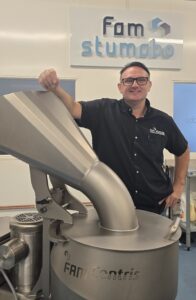
The good news is there’s an increase in demand for pre-cut poultry products at the premium end, particularly among manufacturers supplying retailers, ready-meal brands and the food-to-go sector. “At the premium end, convenience should still look freshly prepared,” Banner points out. Examples include substantial, recognisable chicken pieces in premium ready meals, neatly presented fillet slices in sandwiches and salads, and pulled chicken with an irregular, hand-prepared appearance for wraps and meal bowls.
“The key distinction is visual and sensory: a clean cut, an appealing texture and pieces that retain their natural character,” he says. “For manufacturers, the challenge is reproducing that premium appearance across thousands of portions.”
JBT Marel points out that as chickens continue to grow larger, individual portions are becoming too large for many smaller households. As a result, portioning boneless products has become virtually obligatory to deliver portions with the right size and weight for consumers. “However, in doing so, processors are looking to optimise their yield and make the most of the least resources,” a spokesman for the manufacturer explains. “Cutting and portioning must be done with great precision and flexibility to minimise giveaway. Intelligent cut-up and portioning solutions can help. With the right combination of hardware and software, they can adapt swiftly to variations in product shape, size, and weight.” This is data-driven process, he says, with automated grading and destination determination enabling processors to maintain product quality and get the most out of their resources.
Processors seek broad functionality
There are a range of aspects that processors are looking for in their machinery right now, and as Banner notes, purchase price is only one side of the story. They are looking closely at total cost of ownership, uptime, maintenance, operator-friendliness and the cost per kilo processed. They also want evidence of all these factors before making an investment.
JBT Marel underlines the view that processors are focused on maximising yield while reducing labour dependency. In the cutting and portioning areas of their factories, this means they are looking beyond large cutting halls where numerous operators perform manual tasks. Instead, automation is the watchword, and this should provide at least the same precision, flexibility, and yield as manual operations – preferably even higher – while delivering much greater throughput capacity.
“The automated system must offer highly accurate product cuts, a higher percentage of products that meet customer specifications, and greater flexibility to produce multiple product formats through easy changeovers, with less giveaway and waste,” Marel says. “Moreover, automated systems offer better traceability and quality control.”
The next frontier of technology
It feels like the discussion around artificial intelligence and its adoption is permeating every area of life right now, and food production is no different. However, while AI and robotics are gaining ground in poultry processing – particularly in inspection, sorting and robotic handling – Banner insists it isn’t a prerequisite for effective automation.
“In cutting, carefully engineered mechanics and reliable machine controls remain fundamental,” he explains. “Equally important is the ability of cutting equipment to communicate and work with upstream and downstream machinery in an integrated production line. Rather than adding AI for its own sake, the priority should be making each stage of the line work together to support a stable, efficient process.”
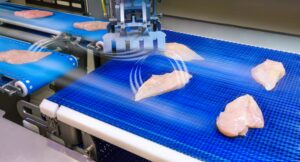
Away from AI, the JBT Marel spokesman is keen to point out that portion cutting isn’t a purely mechanical process any more. It begins with an advanced laser scan to determine the shape, size, and position of the incoming fillet, tenderloin, or thigh. The gathered data is transferred to the machine software, which calculates the best possible cuts based on a pre-programmed recipe.
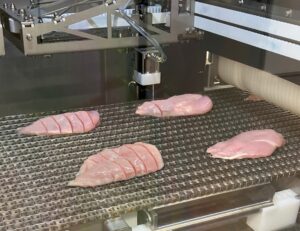
Then, the optimal cut can be made with either a conventional metal blade or a robotised waterjet cutting beam. The latter can create virtually any pattern, including curved shapes and even custom designs such as dinosaurs or flowers. Offcuts are never thrown away but re-used for smaller or further processed products.
In the cutting and portioning departments, JBT Marel says the focus is all about weighing, grading, monitoring, calculating, and positioning products to provide the foundation and data-driven insights needed to achieve consistently perfect cuts.
That includes the involvement of intelligent software, with JBT Marel pointing to its AXIN, which operates at both the machine and process levels to connect all equipment. “Combined with advanced weighing technology, cameras, lasers, sensors, and together with smart, self-learning machine software, reliable, data-driven decision-making is made possible,” the company says. “These real-time decisions, for example regarding the final product destination, are therefore based solely on software intelligence, without human intervention.”
Sustainable processing
Energy efficiency and sustainability have become major factors for poultry processors to consider when investing in machinery, and as JBT Marel notes, maximising ‘carcass balance’ is an important sustainability measure that also improves yield.
In the portioning area, the Marel spokesman notes that maximum use of the available material is a hot topic, with every cut aiming to minimise giveaway and make use of the offcuts as valuable material. “A perfect example of this is the I-Cut 122 TrimSort, a portion cutter with two separate outfeed belts,” he says. “After precise cutting according to a preset recipe, the main product (mostly a fillet or strips) continues on the top belt. However, the cut is done in such a way that the offcut remains a valuable product. Via the lower belt, the offcuts can be transported to another process where they can be turned into fixed-weight strips or cubes.”
Intelligent portioning with maximum utilisation can also be done with the DSI Waterjet Cutter, he adds. This portioner, with its robotised water beam, scans every incoming individual fillet and calculates in real time the optimal cutting pattern to cut out as many valuable products as possible from the available shape and size.
Sustainability will no doubt continue to be one of a number of significant considerations going forward, and as wider technology advances, processors can expect a raft of other exciting new developments in the months and years ahead.
New technology takes poultry processing to the next level
JBT Marel’s recent developments focus on combining advanced cutting and portioning equipment with intelligent software and inspection technologies. Across the production line, its AXIN software has been developed to link the processing equipment at the machine level and process level, allowing for elaborate control and monitoring of the process to ensure maximum utilisation and avoiding yield losses.
The ACM-NT cut-up system integrates production data, weighing systems, and vision technology to improve grading accuracy and optimise cut-up decisions in real time. Technologies such as PDS distribution software, SmartWeigher systems, and IRIS visual grading intelligence help processors increase the percentage of products that meet market specifications.
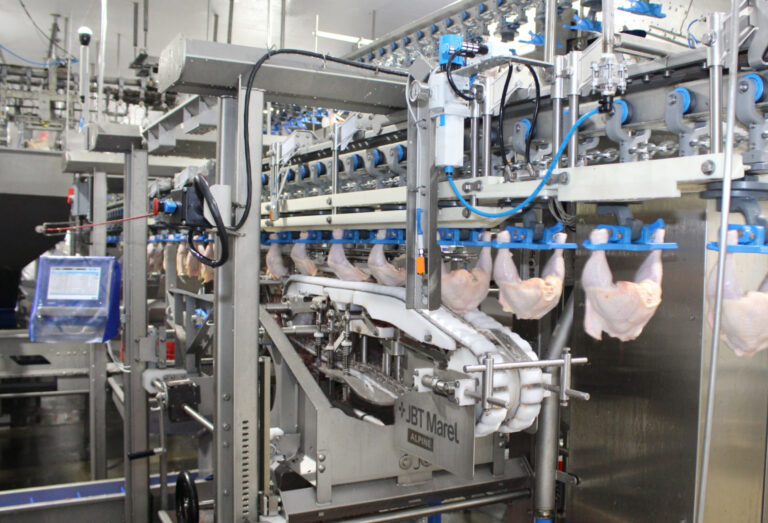
The company points to new cutting modules such as ALPINE, WingMaster, and the Q-Wing setup, which combine mechanical handling with digital control. The aim is to mimic manual cutting operations as closely as possible, with at least the same yield and higher capacity. Via touchscreens, specific cutting recipes can be selected, followed by automatic adjustments of the machine settings, guaranteeing optimal cuts for each flock or lot.
FAM STUMABO points to three complementary technologies that match the cutting principle to the poultry product’s texture, shape and condition.
The Yuran Hytec 300 EC is a belt-fed solution for dice, strips, chunks and pulled-look shreds. Its independently controlled cutting speeds support different formats, while the integrated exit conveyor makes it easier to transfer cut product to the next stage.
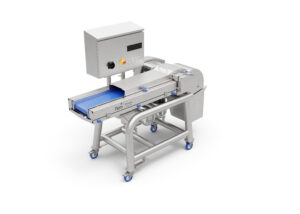
The robust CMD.2 is built for high-capacity dicing and strip-cutting, including demanding cooked and tempered-frozen poultry applications.
For accurate slices of chicken fillets, the Volantis uses a long V-belt infeed to align the product before transverse cutting. This helps deliver uniform slices with a clean appearance at production scale. “The quality of STUMABO cutting tools is equally important in ensuring cut quality, yield and consistency,” the company says.
Weber expanded its range this summer with the introduction of a new slicing platform in the weSLICE 2000 and weSLICE 2500.
The Weber weSLICE 2000 is a circular blade slicer, capable of cutting up to 330mm utilising the Weber Durablade. The weSLICE 2500, meanwhile, has a cutting height of up to 180mm, making it well suited to large, natural artisan products.
Both models are designed for food processors that need reliable industrial slicing performance without the footprint of a larger high-capacity slicing line, according to the company. This makes the range particularly relevant for small-to-medium production environments, component manufacturing and producers looking to upgrade from manual or semi-automated slicing.
Earlier this year Sanovo introduced the Cook2Peel Pro Peeler, a solution designed to improve efficiency and consistency in egg peeling operations.
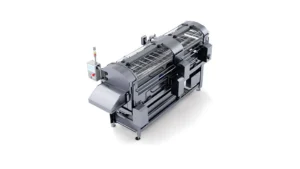
The Cook2Peel Pro Peeler addresses the desire to maximise yield while maintaining high product quality by enabling stable, reliable peeling performance across varying production conditions.
Developed with a focus on operational efficiency, the solution supports streamlined workflows and reduced product loss, Sanovo explains.
Moba research focuses on boosting efficiency
Egg industry solutions provider Moba has revealed how it is working to help boost efficiency for its customer base.
The update came as the company reported a solid performance for the third quarter, highlighting strong demand, targeted investments in operational efficiency and innovation.
On the operational side Moba explained that it is now carrying out advanced research into how machine data can provide users with greater insight and help them improve operational efficiency. By turning data from connected equipment into practical insights, it explained, that work can support better-informed decisions, improved process control, and more effective use of resources.
The aim is to make solutions accessible through the myMoba digital portal that provides egg producers with greater operational visibility and control. The rollout of the myMoba platform is scheduled to begin in late 2026.
Overall for the third quarter, the Dutch manufacturer said that customers continued to invest in automation, productivity, and food safety solutions during the third quarter of 2026, leading to steady demand throughout the year to date.
Although order intake normalised from the “exceptional” levels recorded last year, Moba stressed it maintains a promising order book, providing a good basis for continued activity. Revenue continued strongly, and based on the current trajectory, 2026 is expected to close above the 2025 level.
During the quarter, further improvements were made to line assembly, logistics, and supply chain processes. “These changes are intended to support faster, more predictable delivery and a more responsive service as customer needs evolve,” the company said.
Improvements in spare parts availability, service processes, and feedback resolution will also help customers limit downtime, maintain reliable system performance, and operate more efficiently over the longer term, it added.