



The free range egg sector is celebrating healthy returns, but the shadow of avian influenza looms large
Barney Kay opened this year’s BFREPA Live, held at the Telford International Centre on 27 November. Noble Foods’ agriculture director began by acknowledging the toll avian influenza continues to take on UK producers.
He said the sector “understand[s] the huge amount of work it takes to get a business back up and running again” after avian influenza, noting the “major financial impact” and “significant stress” it causes.
He urged producers to improve biosecurity. Many issues are simple, he said, including “maintaining water systems and roof gutters…improving vermin control,” and reducing the risk of infection being carried in on footwear. “Anything too complicated is likely to fail when the pressure is on.”

Kay said the UK must understand what is required to make vaccination viable, “We need to understand what it would take to make vaccination a logistical and commercial reality in the UK.”
Kay warned of growing import pressures, especially from Ukraine. He cited “high risks of salmonella” and concerns about the “quality, welfare, and provenance” of some imported eggs.
Kay reported strong demand, saying egg consumption is “growing at roughly 5% year-on-year” and shows “no signs of slowing.” New entrants are investing heavily, an “interesting development” as companies look to “capture growth in the market.”
He concluded: “We must remember we are producing a healthy product at a fair value for the world, in a responsible and sustainable way.”
Policy and trade
Delegates also heard from former Defra secretary of state George Eustice, who told the conference that the free-range egg sector remains a major agricultural success, with strong welfare standards, consumer confidence and market growth. But he warned that avian influenza “remains a serious challenge” and said the industry must stay prepared for rapid change.
Eustice outlined the principles behind the post-Brexit agricultural reforms he introduced, saying leaving the EU allowed the UK to move away from a “bureaucratic” CAP and towards Environmental Land Management schemes that reward outcomes such as soil health, water quality, biodiversity and animal welfare.
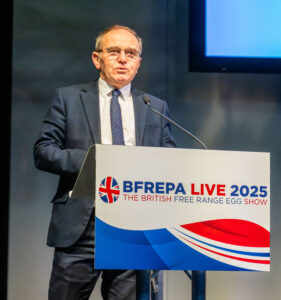
On trade, Eustice warned that the UK must maintain its standards in all deals. “It’s well known that I disagreed with elements of the Australia trade agreement,” he said. “ I was not against doing a deal with Australia – far from it – but I believed strongly that the UK should protect its values and standards in all trade agreements. I argued that tariff-free access should not be granted unconditionally without proper safeguards. It was disappointing that I was unable to persuade colleagues at the time.” He said the temporary liberalisation of imports from Ukraine should now be reviewed.
Veterinary insights
UK chief veterinary officer Christine Middlemiss warned that the poultry sector is facing into “another difficult year” of avian influenza.
Addressing producers at the conference, Middlemiss confirmed that officials “confirmed another infected premises yesterday morning.” She reminded the sector that the UK has not seen full AI freedom since March 2021, noting: “Since then, we have not returned to freedom because of the continual circulation of H5N1.”
The disease has now run for “three full years of continuous virus activity” without a summer break. Middlemiss said this persistence has been driven by changes in wild-bird epidemiology: “Virus behaviour in wild birds has changed.” Some migratory species are now overwintering with infection, she said, and “transmission back into domestic poultry is occurring repeatedly.”
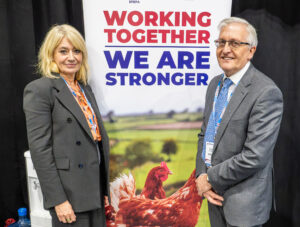
Middlemiss noted that the dominant strain remains H5N1 but highlighted ongoing genetic drift and the emergence of a genotype linked to dairy cattle infections in the US. While this represents adaptation “towards mammals,” she stressed this has not been detected in UK livestock.
Gordon Hickman, who heads the UK’s avian influenza response team, said UK mammal detections remain limited to scavengers such as foxes, otters and seals, and there is “no evidence at this stage of sustained mammal-to-mammal transmission in the UK.”
Both officials underscored that tightened biosecurity remains the sector’s strongest defence. Hickman reminded producers that effective biosecurity is “not just about boot dips and disinfectant” but must include “physical barriers, behavioural change, staff training,” and strict control of people, vehicles and equipment. “It requires constant attention, especially during high-risk periods,” he said.
On vaccination, Hickman spoke about field trials with France, the Netherlands and other partners. In the UK, he said officials are seeking vaccines that “prevent clinical disease, reduce shedding, and allow us to distinguish vaccinated from infected birds,” adding: “Vaccination is not a quick solution but it is part of long-term planning.”
During the Q&A, Middlemiss reiterated that any premises under restriction must follow statutory controls and cannot admit public visitors. She emphasised: “Please immediately report any suspected disease.” She added that the human health risk “remains very low,” with global cases almost always arising from close, direct contact with infected birds or mammals.
International perspectives
Dutch poultry farmer Eric Hubers told the audience about the pressures facing European poultry producers and how environmental rules, welfare mandates and political uncertainty are escalating to the point where “many of us no longer feel we have space to farm.”
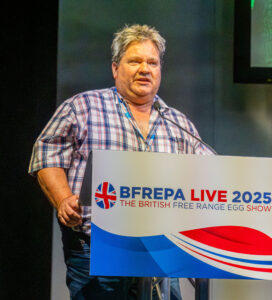
Hubers, whose family has farmed since 1893, described how the Dutch government’s buyout schemes and regulatory pressure are transforming entire farming regions. “Many of my neighbours have already been bought out… Investment becomes difficult when you don’t know if you’ll be told to shut down in a few years,” he said.
Hubers warned UK producers to learn from the Dutch experience with welfare labelling schemes. He noted that the Beter Leven star system originally intended to guide consumer choice, has created unrealistic expectations.
“Only a very small percentage of consumers buy the highest-star eggs. Most buy the cheapest,” he said. Retailers, he added, use higher-welfare tiers to depress producer prices, not enhance them. Policymakers now act “as though it is the new normal,” despite the label’s founders admitting “this was only ever for a niche market.”
Hubers highlighted how even compliant systems attract criticism. Exhaust fans in modern aviaries produce visible dust plumes despite meeting regulatory limits. “Some activists film the dust cloud and say: ‘Look, pollution!’ Even though the system meets all regulations,” he said. “The public sees something, not the data.”
Turning to AI, he said Europe has lost “enormous numbers of birds,” prompting France, the Netherlands and Germany to advance vaccination work. But the rollout will be complex: “Vaccinated birds can still carry virus… exporting vaccinated eggs and poultry is still a political question… but still—it is probably the future.”
Environmental constraints are becoming unworkable for many Dutch units. Hubers said his 7.5-hectare farm must meet the same emissions standards as much larger operations. New Dutch carbon rules demand levels “below 15 kg of CO₂ equivalent per hen place—and soon even lower.”
“It is almost impossible,” he told producers. “Sometimes it feels as though policymakers want fewer farms, not better farms.”
Hubers closed with a personal account of nearly exiting the industry. “I thought: ‘I cannot continue with this pressure.’” A government buyout offer was low at the time and later rose to four times the value. “If I had sold earlier, I would now have nothing… If you sell early, you regret it. If you wait, you regret it,” he said, describing the toll of “the fear of disease, the media pressure, the political pressure, and the responsibility for staff and animals.”
While he ultimately stayed in farming, he warned that many colleagues have not. “That loss of knowledge, of families, of community is the hardest part,” he said.
Hubers ended with a clear message for UK producers: “The UK still has advantages… more land around farms, more political stability, more room for development. Use it.”
Farming her way
Northern Ireland poultry producer Kathy Gibson told delegates that although the UK layer sector continues to grow, every region faces its own pressures and farmers benefit enormously from sharing experience. “It’s good to come together and share ideas because no matter where you farm, you’re always learning from someone else,” she said.
“We do things differently from our parents’ generation, but in many ways we’re just continuing the same story,” Gibson said. “When we first started, we were as green as grass… farming poultry is a completely different world. Things go wrong. Things break. Birds surprise you.”
She emphasised the importance of local support networks. “We had good neighbours, good vets, good advisors and that makes such a difference in this industry,” she said.
One of their earliest decisions was choosing a breed. “We visited several farms, we asked too many questions, we annoyed quite a few reps, but eventually we settled on a breed we felt confident in,” Gibson explained. The flock performed strongly, holding persistency and avoiding weight problems. “Some of it is good management, but some of it is simply learning from experience and being willing to change when something isn’t working,” she added.
Gibson said supermarket visits to the farm had been surprisingly positive. “It’s a good thing… it reminds us that what we do matters, that people value the product, and that we’re not invisible,” she said. We’re proud of what we do. We’re proud of our birds. And we’re proud to be part of this industry.”
Robbie Moore MP on farming and government engagement
Shadow farming minister Robbie Moore MP was the last speaker of the day. He told delegates he had spent recent weeks “putting the miles in” to meet several producers.
He briefly served as a Defra minister in the previous government and said his commitment to agriculture was rooted in first-hand experience. Before entering Parliament, he spent over a decade as a land agent. “Much of that time was spent travelling across rural areas often in the dark, usually in the rain dealing with the realities that you all live with every day,” he said.
He added: “Every pound in a farming business has to work hard. Every decision carries risk.”
Reflecting on the past 12 months, Moore said many producers had faced “decisions under immense pressure”, from disease outbreaks to supply chain instability. “There were moments when people forced into those choices felt completely stuck. I hear that. And I recognise it,” he said.
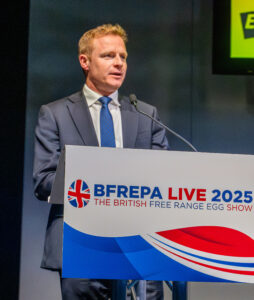
A central theme of Moore’s speech was the need for government to reduce administrative burdens. “My view is simple: government should get out of the way where possible, and create the conditions that allow businesses to grow,” he argued. That meant “clearer regulation, quicker processes, and departments that support enterprise rather than hinder it.”
He also criticised the political turbulence that has seen “11 secretaries of state in 10 years”. Constant turnover, he warned, weakens Defra’s influence. “Departments lose direction, lose influence, and are not listened to around the Cabinet table in the way they should be,” he said. “A department like Defra has to be stable, influential, and respected, otherwise rural voices simply aren’t heard.”
Addressing frustration in the room about poor engagement from some MPs, Moore urged producers to keep pushing their representatives. “MPs should be responding. They should be listening. They should be showing up – not just for photo opportunities but for real conversations,” he said.
He stressed that elected representatives must be prepared to “hear uncomfortable truths” and defend their decisions transparently.
New talent
Moore also encouraged younger people considering agricultural careers to get involved now rather than wait for perfect conditions. “Bring your enthusiasm, bring your skills, and get stuck in,” he said. “The industry will value you if you bring something real to the table.”