

Two years after O2Agri developed one of poultry’s most intriguing new technologies, the hyper-oxygenated water system is beginning to move beyond early promise and into commercial reality.
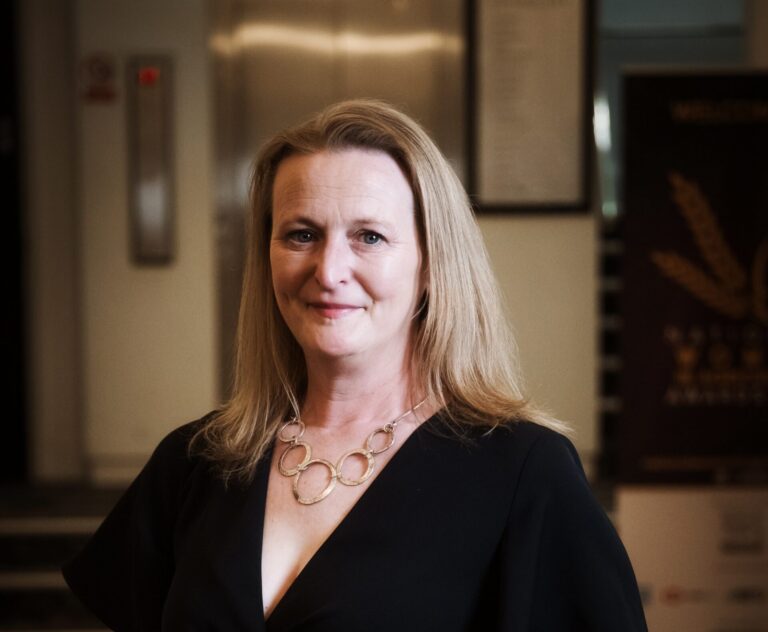
What began as an ambitious innovation built around nanobubble technology and “super-water” has now been installed on 12 commercial poultry units, with managing director and co-founder Caroline Wellon saying the results are reinforcing the strong performance seen in the company’s early trials.
“We’ve got 12 units in and the farmers are reaping the benefits,” she says. For Wellon, the past two years have been focused on proving that the company – now known as O2Agri – could deliver measurable benefits not just in controlled trials, but under real commercial conditions on working poultry farms.
Based on the latest data, she believes that case is becoming increasingly compelling.
Commercial performance
When the system was first introduced, trial data from around five million broilers suggested a wide range of benefits, including reduced mortality, improved feed conversion, stronger bone development and lower factory rejects.
Now, Wellon says the dataset has grown significantly.
“We’ve got all the valid data from over 50 million chickens,” she says.
And the same performance trends are continuing to emerge.
“We’re seeing an increase in FCR. We’re seeing an increase in EPEF. We’re seeing more consistent weight gain over the growth of the birds.”
One of the more interesting findings, she says, is the consistency of daily growth.
“Traditionally, birds might have a growth spurt to start with or to end with, whereas we’re seeing daily weight gain that’s more consistent across the whole growing period.”
Mortality reductions are also continuing. “We’re seeing less mortality, and we’re seeing fewer leg culls.”
Leg strength, in particular, appears to be improving. “The legs are a lot stronger, so we’re seeing fewer issues later in the cycle, which is fantastic.”
How it works
At the heart of O2Agri is a system that injects billions of microscopic oxygen bubbles into poultry drinking water, dramatically increasing oxygen saturation beyond what would normally be possible.
These nanobubbles are invisible to the eye and are designed to carry oxygen more effectively through replace with into the bird the bird’s system, while also helping maintain cleaner drinker lines and reducing microbial pressure.
While the science can sound complex, Wellon says the practical message is straightforward.
“The hyper-oxygenation is easy to explain,” she says. “The nanobubbles are such a strange concept, but they’re so small that they can move the oxygen around the chicken far better.”
The business increasingly prefers to focus on the practical outcomes rather than the technical terminology and for producers, those outcomes are becoming easier to understand.
Faster starts, better resilience
According to Wellon, one of the most important advantages comes right at the beginning of the production cycle.
“Pretty much straight away,” she says, when asked how quickly results become visible.
She points to the critical importance of the first few days in a chick’s life.
“I learned that day one to three is the most important time in a chicken’s life. If they’re drinking our water from day dot, then they’re on a better trajectory to remain healthy.”
She also believes the technology can help birds recover faster when they arrive carrying early health challenges.
“If chickens come in with a burden, which sometimes they do, because the hatcheries have a burden, our water may sustain the bird better.
“They may again change to overcome that burden faster.”
That improved resilience may also explain some of the efficiency gains farmers are seeing.
“Their thermal tolerance is a lot better, so they don’t have to eat as much to maintain homeostasis,” she says.
“That’s where they’re seeing the increases, because they’re not eating as much as birds that aren’t on our water.”
ROI improving
When the water was first launched, the company estimated a return on investment in less than 18 months. Wellon now believes that timeline has shortened. “I’d say 12 months.”
The savings are being driven primarily by improved feed conversion, lower mortality, reduced rejects and lower reliance on chemical treatments.
One of the original ambitions behind the system was to reduce the need for chemical disinfectants in poultry water systems, and Wellon says meaningful progress is being made.
“On one farm, they haven’t used chemical for three years,” she says.
“On other farms, because the water isn’t of the quality that it needs to be – for example bore hole water – we still need to use chemical to ensure that the lines are kept clear.”
But even where chemicals remain necessary, usage is significantly lower.
“There’s definitely a massive reduction in chemical.”

Easy installation and remote monitoring
Practicality has been key to commercial adoption.
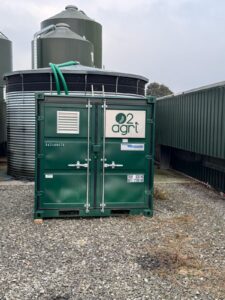
The company has now moved to a containerised installation model, allowing systems to be added with minimal disruption.
“We can retrofit it into the water treatment room if we can’t get the container in, but we have actually craned a container in, which was exciting.”
Installation is rapid. “From delivery to turning it on, you’re looking at about 48 hours.”
Daily management requirements for producers are also minimal. “They’re all remotely monitored, they’re all remotely accessed,” she says.
The forgotten nutrient
Despite water making up most of the bird, Wellon believes it remains overlooked in many nutrition and health discussions. “Water isn’t really talked about. It’s the forgotten nutrient. It’s just taken for granted, I think.”
But she senses attitudes are shifting. At recent events such as the British Pig & Poultry Fair and the WPSA conference in Manchester, she says interest was notably stronger.
“We had a lot of people coming to the stand saying, ‘I’ve been told to come and find you.’”
“That was really encouraging, because people are actually open to discussing the idea of, ‘Well, let’s look after your water.’”
Layers, rearing and international growth
Although current installations remain focused largely on broilers, expansion is already under way.
“Layers start in July,” says Wellon.
The company is particularly excited about upcoming rearing trials.
“We’re really, really excited about the rearers’ trial.”
Because pullets remain on the system longer, she believes the benefits may become even more pronounced.
“We believe that because chickens drink our water for longer, they’ll see much better results.”
A second commercial trial with a major egg producer is also planned.
“We’re going to have a like-for-like. We’ll have a control and our water, so we’ve got three kinds of tests going on.”
Internationally, Australia is emerging as a major focus.
Through two Innovate UK-funded programmes, Wellon has already visited the country to explore opportunities. “They were very open,” she says. “Australia is very open to ag-tech, very open to new innovation.”
Water management also carries greater strategic importance there. “All they talked about was water. It’s a very good market over there.”
A growing leadership role
As the business has grown, so too has Wellon’s role. “I’ve always been managing director and co-founder,” she says. “But now my role has just exploded. It’s all-consuming.”
She now leads customer development, account management, data gathering and commercial expansion. “I’m pushing for the trials, I’m pushing for new customers, pushing for data.”
Her agricultural roots run deep. “I’ve always been in agriculture – a dairy farmer’s daughter. I’ve been working in ag since I could stand up.”
After studying agriculture at Harper Adams and building a career across crop production and logistics, entrepreneurship was always part of the plan.
“I’ve always had an urge to run my own business. It was just about waiting for the right time and the right opportunity.”
Recognition for women in agriculture
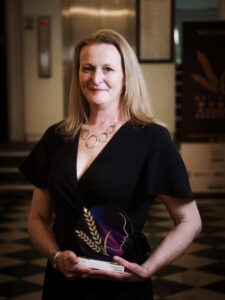
That journey was recently recognised when Wellon won a National Women in Agriculture award for innovator of the year, something she says was both unexpected and deeply meaningful.
“It was an amazing experience and a real honour to even be nominated and shortlisted.
“To win was just so unexpected.”
She also sees the recognition as part of a broader shift. “It was so nice to have so many women being championed in agriculture.”
“We can only grow”
For Wellon, the long-term ambition is straightforward: wider adoption, healthier birds and a more sustainable poultry industry. “The more people who adopt our system and make their businesses more sustainable, more environmentally friendly, it can only be beneficial.”
“For the farmers, the chickens and the environment.”
And as for how far the technology can go? “There really isn’t any kind of limit to this tech. We can only grow,” she says.