


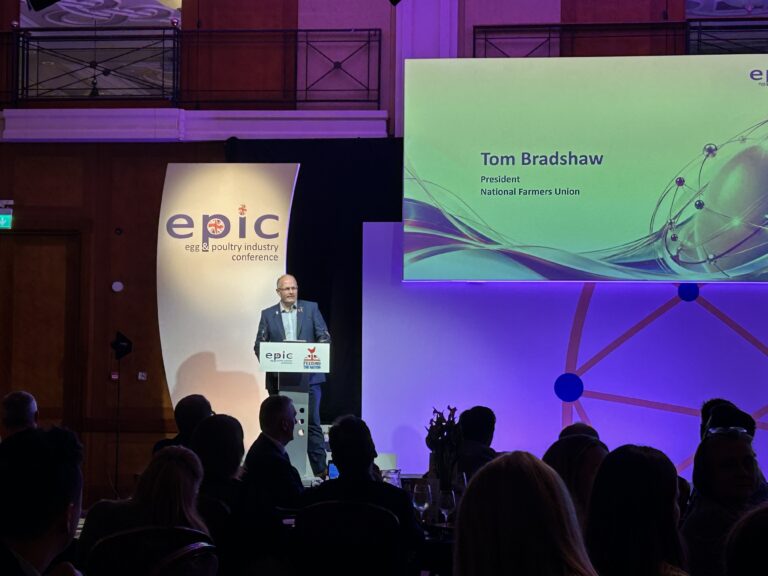
NFU president Tom Bradshaw has warned that the UK’s poultry industry is being held back by planning delays, unfair competition from imports and a lack of government urgency around domestic food production.
Addressing the EPIC conference in Newport on 1 November, Bradshaw said the poultry sector had a strong growth opportunity, driven by demand for affordable protein and high standards of animal health and welfare, but farmers were increasingly frustrated by barriers to investment.
He described last week’s Budget as a major disappointment for farming, warning that food production was being taken for granted at a time of growing geopolitical uncertainty and climate-related pressures on global food supplies.
“Investing in our food system here must be a political imperative,” he said. “Yet at the moment, it’s completely taken for granted that you in this room will keep on doing it, and you’ll be able to do it whatever the challenges are.”
Planning was one of the biggest obstacles to poultry expansion, he said, with producers facing lengthy delays, mounting costs and the threat of judicial reviews.
“What really frustrates me about the planning system is that it seems to be a case of how can we stop this application, rather than how can we enable this application?” he said.
Bradshaw warned that the industry could not afford to wait another 18 months for improvements, particularly given the risk of losing retailer commitments to British-sourced poultry.
He welcomed the Government’s Farming and Food Partnership Board, established following the Baroness Minette Batters review, and its work on a poultry growth strategy. However, he questioned whether it would deliver change quickly enough to meet the sector’s pent-up demand for investment.
He also called for greater parity between domestic production standards and those applying to imported food, arguing that British producers should not be expected to compete against products produced to lower standards.
Referring to recent food safety concerns involving imported eggs, he warned that consumer confidence could be damaged if shoppers were unable to distinguish between British and imported products.
“If we want to have the higher standards in the world, it’s only fair that the food that we import should be produced to those same standards,” he said.
Bradshaw also criticised animal activism and campaigns against intensive livestock production, arguing that restricting domestic production could simply lead to greater reliance on imports from countries with lower welfare standards.
“If it was about animal welfare, they would be trying to enable you to produce more here, so that we rely on less imports, because that’s how you improve animal welfare,” he said.
He highlighted the importance of maintaining the industry’s social licence to operate, warning that prolonged undercover investigations were often aimed at stopping agricultural production rather than addressing individual welfare concerns.
Bradshaw also called for changes to the annual investment allowance to encourage more on-farm infrastructure investment, including raising the threshold and extending relief to buildings and structures.
He said a stronger domestic food production base was essential to national resilience, particularly given growing international instability.
“If we’re serious about dealing with global conflict, if we genuinely need to spend 3% on defence, the other side of that coin has to be food security,” he said.
He urged the Government to recognise the poultry sector’s appetite for investment and growth, but warned that producers were increasingly being forced to put investment plans on hold because of the barriers they faced.