


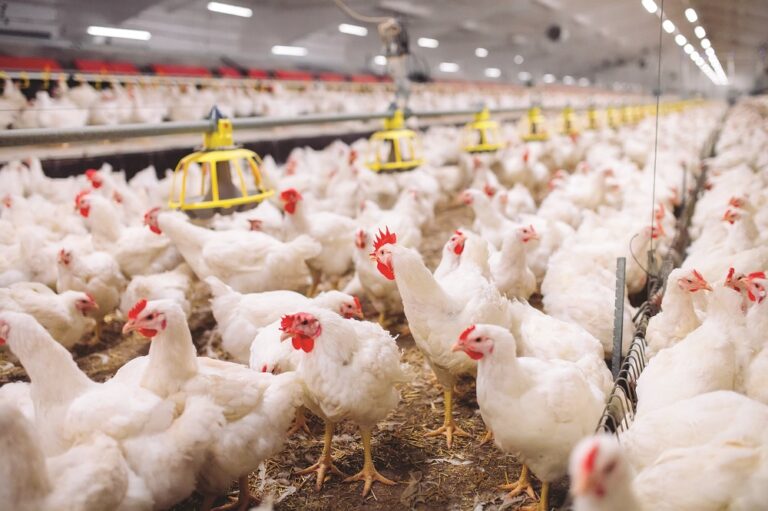
Farmers are ready to invest in new poultry housing, but planning delays and environmental challenges are creating growing uncertainty over the future of British chicken production.
The NFU’s warning that Britain’s poultry sector is being held back by planning delays reflects a growing challenge facing producers across the country: how to modernise and expand domestic chicken production while operating under increasingly intense environmental scrutiny.
Launching its new #LoveBritishChicken campaign in May, the NFU said “excessive planning delays, inconsistent local decisions and systematic barriers” were preventing poultry producers from creating the housing needed to meet rising demand for British chicken. According to the NFU’s 2025 broiler shed survey, the average UK broiler house is now more than 30 years old, while 15% of sheds still in production are at least 50 years old.
Many older poultry buildings were designed for a very different production environment and lack the efficiency, ventilation and environmental control systems now available in modern units. Producers argue that replacing ageing sheds with newer buildings could improve bird welfare, reduce energy use and help farms remain commercially viable in an increasingly competitive market.
NFU Poultry Board chair Will Raw said producers were “eager to invest, modernise, and future-proof their businesses to help feed the nation”, but were being “trapped in a planning system of endless delays and obstruction”.
“When applications are in limbo or we are blocked from building new poultry housing – or upgrading ventilation and windows in older units – it stymies growth and directly harms on-farm innovation and efficiency,” he said.
The NFU estimates that more than 1,000 new poultry sheds will be needed to keep pace with growing consumer demand for chicken. Raw also warned that continued delays could ultimately lead to more imports entering the UK market from countries operating to lower production standards.
“Without urgent change, we risk displacing British production with chicken produced overseas – from countries where food is allowed to be produced in ways that are illegal here,” he said.
However, the industry’s planning difficulties are increasingly linked to a wider debate over river pollution, nutrient management and the cumulative impact of livestock production in certain parts of the country.
That debate has become particularly prominent in areas linked to the River Wye and River Severn catchments, where campaigners, regulators and local authorities are paying closer attention to the environmental impact of poultry expansion.
One of the most significant recent cases emerged in Shropshire, where the High Court overturned planning permission for a proposed 200,000-bird poultry unit near Shrewsbury after a legal challenge backed by environmental campaign group River Action. The court ruled that Shropshire Council had failed to properly assess the cumulative environmental effects associated with manure and digestate spreading linked to the development.
The case is now widely viewed as a potentially important precedent for future poultry planning applications because it places greater emphasis on assessing wider catchment impacts rather than considering developments in isolation.
Following the ruling, River Action campaigner Dr Alison Caffyn said: “This ruling proves what we’ve said all along: the planning system has been putting our rivers at risk.”
Campaigners argued that councils were failing to adequately account for the combined impact of multiple livestock developments operating within environmentally sensitive catchments. During the judicial review proceedings, Caffyn also claimed that “there are now nearly 65 chickens for every person in Shropshire and the council is allowing even more”.
For poultry producers, there is growing concern that planning decisions are becoming increasingly uncertain and vulnerable to legal challenge, even where farms are attempting to modernise existing operations rather than dramatically expand production.
Legal challenges and judicial reviews are likely to remain an important feature of future poultry planning disputes, particularly where river pollution concerns are involved.
As a result, planning is no longer simply an administrative hurdle for the poultry sector. It is increasingly becoming one of the defining issues shaping where and how British poultry production develops over the coming decade.
The challenge for policymakers will be balancing the industry’s push for investment and modernisation against mounting environmental pressure for stricter oversight. For poultry producers, the outcome of that debate may determine not only how quickly farms can expand, but whether the next generation of poultry housing can be built at all.