


An independent ammonia abatement trial carried out by Charman Ag, in collaboration with Lallemand Animal Nutrition, has demonstrated that targeted microbial interventions can deliver a substantial reduction in ammonia emissions from commercial broiler housing, without the need for capital investment.
The yearlong study evaluated the use of the probiotic supplement Bactocell Drink in conjunction with the building surface application of Lalfilm PRO, a positive biofilm-forming bacterial complex. Results showed a 42% reduction in ammonia emissions across the year, alongside lower inhouse ammonia concentrations.
For broiler producers facing increasing pressure to manage ammonia, these findings highlight a practical, cost-effective approach that can be implemented in existing buildings without infrastructure change.
Trial design
Emissions data was collected from two commercial broiler sheds, one treatment and one control, over a period of 12 months, capturing ammonia across all seasons, reflecting real world variation in weather, ventilation demand, and crop performance.
Sheds were conventionally managed, each housing approximately 17,500 Red Tractor stocked broilers in the East Riding area of Yorkshire.
Ammonia concentrations in sheds were measured continuously in real time using tuneable diode laser absorption spectroscopy (TDLAS), accounting for ventilation rates and climate to allow accurate calculation of ammonia emissions expressed in kilograms of ammonia per animal place per year (kg NH₃/ap/year).
The trial design and monitoring methodology followed VERA guidelines and protocols, utilising Charman Ag’s proprietary technology, and established experience in quantifying ammonia emissions from commercial livestock systems for industry, governmental and non-governmental bodies.
Dom Charman of Charman Ag explains: “By capturing continuous emissions and ventilation data over a full year, we were able to account for seasonal variation and management changes. This ensures any differences observed between the control and treatment sheds can be robustly attributed to the microbial interventions rather than external factors.”
Treatment approach
A combined microbial strategy was adopted to explore the best possible outcome for ammonia reduction. Lalfilm PRO, containing selected beneficial biofilm-forming bacteria, was applied once per crop by fogging the building after cleaning and disinfection, and before chick placement. The product was misted onto walls, ceilings, litter, and feeding and drinking equipment to establish a positive microbial biofilm on internal surfaces.
Bactocell Drink was applied on crumb feed at placement and via the drinking water at defined stress points, including early life, around Gumboro vaccination, ahead of feed changes, and prior to thinning.
Trial results
Charman says analysis of the full dataset shows a clear and verifiable reduction in ammonia emissions from the shed receiving the microbial interventions.
“Using a validated emissions monitoring approach, the treatment shed produced lower ammonia concentrations and emissions than the control shed across the year,” he explains.
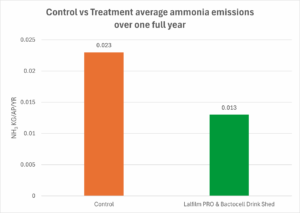
The control shed recorded an annual ammonia emission factor of 0.023kg NH₃/ap/year, closely aligning with the current benchmark value of 0.024kg NH₃/ap/year. This confirmed that the control building was representative of a well-managed conventional broiler system.
In contrast, the treatment shed, receiving the microbial interventions recorded a mean annual ammonia emission factor of 0.013kg NH₃/ap/year, 42% lower than the control, with results passing all robustness checks.
“This gives a high level of confidence that the reduction observed is attributable to the treatment protocol,” Charman adds.
While the primary focus of the trial was emissions to air, ammonia concentrations within the treated shed were also significantly reduced.
“Lower inhouse ammonia levels are fundamental to emissions reduction, but they are also relevant to bird welfare outcomes and stockperson exposure,” he says.
Implications for producers
Hannah Elliott, monogastric technical manager for Lallemand Animal Nutrition says the findings demonstrate how commercially available microbial solutions can reduce the environmental impact of existing broiler units.
“Achieving a 42% reduction in ammonia emissions without capital investment or infrastructure change is a significant result for the industry. This protocol for Lalfilm PRO and Bactocell Drink can be applied to any poultry enterprise with a drinking water dosing system for approximately a penny per bird,” she explains.
“The Bactocell Drink probiotic bacteria Pediococcus acidilactici CNCM I – 4622 has been authorised and sold as a gut flora stabiliser since 1999 and registered for all avian species since 2020. Lalfilm Pro has been used by poultry producers in the UK since 2018 as part of environmental and hygiene management routines.” Charman Ag’s ammonia data provides a measured environmental outcome under commercial conditions.