

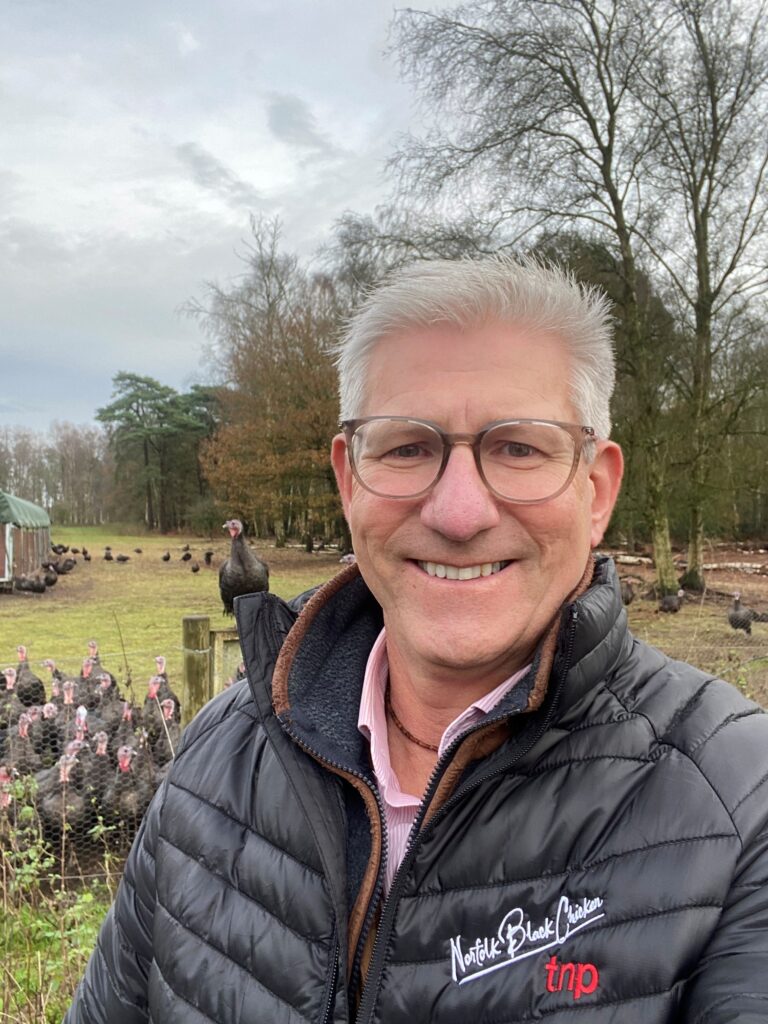
On a bright spring morning, Norfolk poultry farmer Mark Gorton was doing what many farmers across the country have been focused on: drilling crops, managing soil moisture, and making the most of ideal early-season conditions. But beyond the usual rhythms of farm life, Gorton is at the centre of something far more significant for the poultry sector – a pioneering on-farm trial of avian influenza vaccination in turkeys.
“I mean, I’m absolutely chuffed that we’re doing it,” Gorton says. “Having pushed it for many, many years, to actually be running it as well… I think it’s really good, and I’m very proud to be doing it.”
Gorton’s involvement stems from his long-standing campaign for vaccination as part of avian influenza control. After joining the government vaccination task force around 18 months ago, he helped shape discussions around how vaccines could complement, not replace, existing biosecurity measures.
“This isn’t the silver bullet,” he stresses. “We still have to have biosecurity and everything else… this is part and parcel of it.”
When the conversation turned to practical trials, Gorton volunteered his own business, Traditional Norfolk Poultry. “We stuck our hand up and said we’d be very happy to run it,” he explains. “To be fair, we’re probably the right people to be doing it… it’s hugely intrusive, it ties up three different farms for six months.”
Why turkeys?
The decision to focus on turkeys was deliberate. “They seem to be highly susceptible,” Gorton notes, “but also they’re highly valuable.”
He adds that, unlike layers in the Netherlands or ducks in France, turkeys had not yet been tested at farm scale. “There was a gap there… nobody had certainly done it on a farm scale.”
The trial itself is complex and tightly controlled. Birds are vaccinated at day-old in the hatchery using an injectable vaccine, followed by a booster dose later in life.
“In a perfect world, we’d give them the dose in the hatchery and that’d be it,” Gorton says. “But I don’t think that’s going to be the case – it’s probably a two-dose strategy.”
The aim is to ensure immunity lasts throughout the birds’ lifespan, around 24 weeks. “We need to make sure these turkeys carry this immunity right the way through,” he explains.
Several hundred birds are involved, housed in a commercial-scale shed divided into multiple pens. Each bird is individually identifiable, and different groups receive different vaccines, though crucially, the process is “blinded.”
“We don’t know which turkeys have had which vaccine,” Gorton says. “That’s to make sure there’s no bias… because the world is watching this.”
A major component of the trial is surveillance. Even vaccinated birds must be regularly tested to detect any presence of the virus.
“Just because we’ve been vaccinated doesn’t stop us catching COVID,” Gorton explains. “It’s the same with turkeys… it just means it won’t cause the same level of problems.”
This creates a significant burden. “We’re testing every single bird that dies… sending swabs off, recording how long it all takes,” he says. “It’s a huge amount of work.”
And cost remains the biggest barrier to widespread adoption. “The cost of the vaccine… that’s a small part of it,” Gorton says. “It’s the testing that makes it unaffordable.”
Learning from loss
For Gorton, the trial is rooted in hard experience. “In 2022, we lost nine farms, which was 50,000 turkeys and about 300,000 meat birds,” he recalls. “That was the worst.”
While the most recent season has been less severe, losses remain significant. “We’ve still lost hundreds of thousands of birds this year. Others have had even worse.”
He credits improved biosecurity for preventing a repeat of 2022 but warns against complacency. “We can’t sit back.”
Beyond economics, Gorton believes vaccination is essential for ethical and reputational reasons.
“It’s not right to be having a policy that involves just killing everything,” he says. “That’s just morally wrong; and it sits wrong with lots of people.”
He points to the waste of viable food and the toll on mental health. “There’s perfectly good meat and protein, and then it’s being destroyed,” he says. “And the stress it creates – we’ve seen businesses fail because of this.”
Looking ahead
The trial will run for 24 weeks, until July this year. Even if successful, widespread rollout will depend on regulatory changes and cost reductions.
But Gorton is clear on the direction of travel. “We know this strategy isn’t working,” he says. “We have to do something different.”
Vaccination, he argues, must be part of a global approach. “This vaccine is only ever going to work if everybody’s doing it around the world.”
For now, the work continues under intense scrutiny, tight biosecurity, and significant financial pressure.
“It’s hugely expensive for us to run this trial,” Gorton admits. “But we’re doing this for the good of the industry and hopefully it will benefit everyone.”