


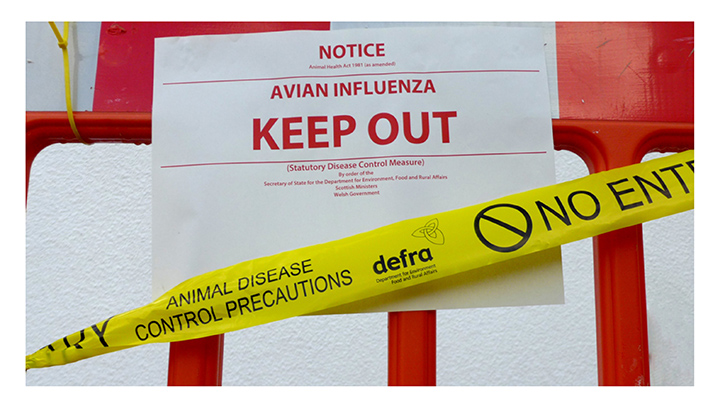
The UK’s avian flu outbreak continues to intensify, with three new cases of highly pathogenic avian influenza (HPAI) H5N1 confirmed in England over the past three days. These latest detections bring the total number of confirmed cases in the 2025-26 season to 58 across the UK.
The most recent case was identified on 30 November at a large commercial poultry unit near Mundford in Breckland, Norfolk. The previous day, on 29 November, another commercial premises near Ashcott, Wells and the Mendip Hills in Somerset tested positive for H5N1. On 28 November, officials also confirmed HPAI H5N1 at a second commercial unit near Gainsborough in West Lindsey, Lincolnshire, where movement restrictions and culling operations are now underway.
These follow an earlier case confirmed on 27 November at a large commercial poultry unit near Ely in East Cambridgeshire, where protection and surveillance zones were similarly implemented.
Housing measures remain in force across England, where they were introduced on 6 November, and across Wales, where they began on 13 November, as part of the ongoing Avian Influenza Prevention Zone. Under these rules, keepers with more than fifty birds must house their flocks, while those with fewer than fifty birds must do so if they sell or give away eggs, meat or live birds. All bird keepers in Great Britain are required by law to comply with strict biosecurity and hygiene requirements to help prevent further spread of the virus.
The first confirmed cases of the season occurred on 9 October in Northern Ireland, on 11 October in England, on 25 October in Wales and on 12 November in Scotland. As a result of ongoing detections, the UK remains classified as not free from highly pathogenic avian influenza under World Organisation for Animal Health rules.
The rising number of cases, including the cluster of recent infections at major commercial sites, suggests that the virus continues to circulate actively as winter approaches. Authorities are urging all flock owners to maintain the highest possible biosecurity standards to reduce the risk of further outbreaks.