


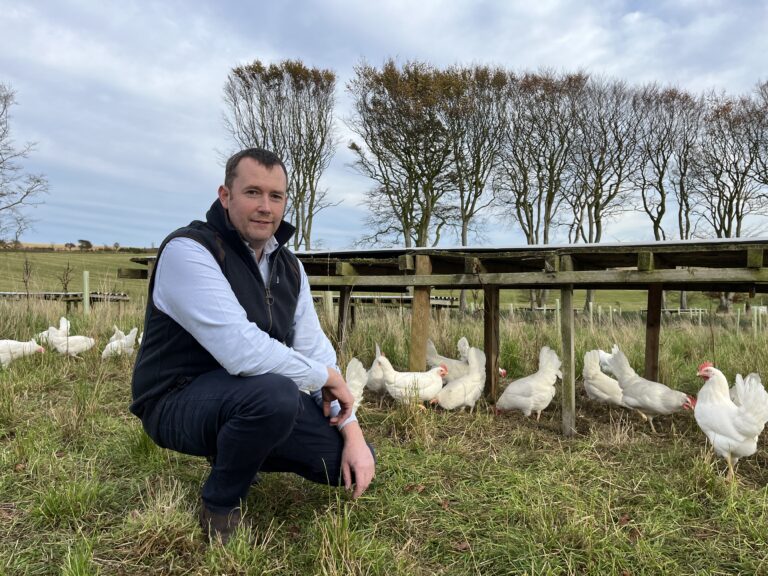
Farmlay placed its expanding poultry and egg operations at the forefront as it welcomed North East MSPs and councillors to Cockmuir Farm outside Strichen on Friday 21 November, during a visit organised as part of Quality Meat Scotland’s (QMS) ‘Meating Our Potential’ campaign.
Although the QMS initiative primarily encourages Scotland’s beef farmers to add two cows to their herds each year to help meet strong consumer demand, the visit to Farmlay highlighted how the company’s large-scale egg business and integrated poultry systems play a crucial role in supporting Scotland’s health, economy and environment.
For many attendees, it was their first time on a working farm, offering a close look at how Scotland’s arable, beef and poultry enterprises link together.
Farmlay managing director Iain Chapman outlined the scale of the business’s egg production and contract producer network: “Seven million eggs are packed on site at Cockmuir each week and we now have 27 contract egg producers stretching from Nairn to Kinross. The business has grown an average of 13% year-on-year to meet demand and continues to supply major retailers, including Aldi and Lidl.”
He also explained how the poultry enterprise underpins the wider integrated system on the family farm. “Both the cattle and poultry manure goes back on to the land to provide nitrogen for our grass and arable crops and much of our wheat and barley is used as feed for the hens.”
Chapman began the tour with an overview of the arable and beef enterprise to show how it fits into the circular system: “Chapman Farm, our arable and beef enterprise, comprises 3,000 acres – 2,200 of arable land with the remainder being grassland, for our cattle, and woodland for the free-range hens to roam. We recently increased our beef suckler herd by 20 cows, bringing the total to 250. All the progenies are fattened on the farm.”
The discussion ranged widely, including the challenges of recruitment for farm roles. Chapman noted: “We currently employ 90 staff locally, with strong retention rates and pay above the national minimum wage. We struggled with recruitment until about a year ago, particularly for the livestock roles, which are physically demanding and need cover seven days a week. We’ve been able to fill these difficult-to-recruit positions by bringing in 20 skilled workers from the Philippines, who have integrated well into our team.”
He emphasised the pace of change across the poultry sector in particular: “This is a high-tech industry now and one full of opportunity, especially within poultry where technology is advancing as rapidly as it is.”
Conversations also covered education and training routes, the need for long-term supply contracts to support investment, and how producers can be encouraged to expand.
QMS Chair Kate Rowell stressed the long-term challenges facing red meat supply: “Livestock numbers are falling due to lack of confidence in recent years and fewer people entering the industry. The average age of a Scottish farmer is said to be 60 years old. Red meat demand looks set to remain high, but supply could fall, which is when imports fill the gap.
“In the UK, people are eating more meat – not less – and this is largely because the UK population is increasing and protein is in high demand, so it’s really important that we look at how we can help producers to maintain and increase herd numbers.”
Scottish Red Meat Resilience Group partners – the Scottish Association of Meat Wholesalers and the Institute of Auctioneers and Appraisers in Scotland – also attended.
Looking ahead, Iain and Robert Chapman closed the visit by outlining future poultry-focused investment: “As we look ahead, five of our existing contract egg producers are currently expanding – providing an additional 176,000 laying hens and we have plans to introduce a new feed mill which will process up to 800-tonnes per week, giving us more control over diets and the quality of finished feed.
“We will continue to invest to ensure we’re as efficient and productive as we can be in the future – playing our part in meeting Scotland’s growing demand for quality, locally produced food.”