


Poultry News
  • Production
    • Broiler Production
    • Ducks
    • Egg Production
    • Game
    • Hatching
    • Housing
    • Turkeys
  • Processing
  • Business & Politics
    • Business
    • Economics
    • EU & Politics
    • Marketing
    • People
    • Training & Education
  • Welfare
    • Environment
    • Food Safety
    • Vet & Medication
    • Welfare
  • Feed
  • Genetics
  • New Products
  • Magazines
    • June 2026
    • 2026 Innovation Supplement
    • 2026 British Pig & Poultry Fair guide
    • May 2026
    • March 2026
    • 2026 Feed & Nutrition supplement
    • February 2026
    • January 2026
    • December 2025
    • November 2025
    • October 2025
    • September 2025
    • 2025 Buildings supplement
    • August 2025
    • 2025 Poultry Health supplement
    • July 2025
    • 2025 National Egg and Poultry Awards finalists supplement
    • June 2025
    • 2025 Innovation supplement
    • May 2025
    • April 2025
    • March 2025
    • 2025 Feed and Nutrition supplement
    • February 2025
    • January 2025
    • December 2024
    • November 2024
    • October 2024
    • September 2024
    • 2024 Building for the Future supplement
    • August 2024
    • 2024 Poultry Health supplement
    • July 2024
    • 2024 National Egg and Poultry Awards finalists supplement
    • June 2024
    • 2024 Innovation supplement
    • Pig & Poultry Fair 2024
    • May 2024
    • April 2024
    • March 2024
    • February 2024
    • January 2024
    • December 2023
    • November 2023
    • Processing Equipment Supplement – Nov 2023
    • October 2023
    • Building Supplement – Sept 2023
    • September 2023
  • Jobs
    • Browse Jobs
    • Post a Job
    • Manage Jobs
  • Events
    • National Egg and Poultry Awards
    • Poultry Fair
    • Webinars
Twitter LinkedIn
  • FREE Email Newsletters
  • About Us
  • Advertise
  • Subscribe
  • Contact Us
Twitter LinkedIn
Podcast
Poultry News
  • Production
    • Broiler Production
    • Ducks
    • Egg Production
    • Game
    • Hatching
    • Housing
    • Turkeys
  • Processing
  • Business & Politics
    • Business
    • Economics
    • EU & Politics
    • Marketing
    • People
    • Training & Education
  • Welfare
    • Environment
    • Food Safety
    • Vet & Medication
    • Welfare
  • Feed
  • Genetics
  • New Products
  • Magazines
    1. June 2026
    2. 2026 Innovation Supplement
    3. 2026 British Pig & Poultry Fair guide
    4. May 2026
    5. March 2026
    6. 2026 Feed & Nutrition supplement
    7. February 2026
    8. January 2026
    9. December 2025
    10. November 2025
    11. October 2025
    12. September 2025
    13. 2025 Buildings supplement
    14. August 2025
    15. 2025 Poultry Health supplement
    16. July 2025
    17. 2025 National Egg and Poultry Awards finalists supplement
    18. June 2025
    19. 2025 Innovation supplement
    20. May 2025
    21. April 2025
    22. March 2025
    23. 2025 Feed and Nutrition supplement
    24. February 2025
    25. January 2025
    26. December 2024
    27. November 2024
    28. October 2024
    29. September 2024
    30. 2024 Building for the Future supplement
    31. August 2024
    32. 2024 Poultry Health supplement
    33. July 2024
    34. 2024 National Egg and Poultry Awards finalists supplement
    35. June 2024
    36. 2024 Innovation supplement
    37. Pig & Poultry Fair 2024
    38. May 2024
    39. April 2024
    40. March 2024
    41. February 2024
    42. January 2024
    43. December 2023
    44. November 2023
    45. Processing Equipment Supplement – Nov 2023
    46. October 2023
    47. Building Supplement – Sept 2023
    48. September 2023
    Featured

    Poultry Business – June 2026 issue out now

    By Chloe RyanJune 8, 2026
    Recent

    Poultry Business – June 2026 issue out now

    June 8, 2026

    2026 Innovation Supplement out now

    June 8, 2026

    2026 British Pig & Poultry Fair guide out now

    May 13, 2026
  • Jobs
    • Browse Jobs
    • Post a Job
    • Manage Jobs
  • Events
    • National Egg and Poultry Awards
    • Poultry Fair
    • Webinars
Twitter LinkedIn
Poultry News
Broiler Production

Feature: Taking steps to reduce ammonia emissions on-farm

Chloe RyanBy Chloe RyanMay 20, 20215 Mins Read
Facebook Twitter LinkedIn Email
Share
Facebook Twitter LinkedIn Email

A combination of bacterial products has had a significant impact on a Gloucestershire broiler grower’s ammonia emissions, Lallemand has discovered. This article was first published in the Innovation supplement to Poultry Business in May 2021

Ammonia emissions are a widely discussed topic in the poultry sector, and they are cited as one of the main reasons why permits for new sites, or unit expansion, are refused. With legislation now in place to reduce emissions from poultry farms, it is not an issue that the industry can ignore.

Modern housing which has better ventilation and heating systems, has been shown to help reduce emissions, however many are still finding ways to make further improvements, as one Gloucestershire grower discovered.

After investing money in improving the house environment and focusing on bird gut health, he noticed a clear positive impact, albeit unintentional, on his ammonia emissions.

“Initially, the farmer noticed that when the contractor visited his 200,000 bird broiler unit at the end of the crop, they weren’t turning on the fans to clean out the house,” says Hannah Elliott, monogastric sales and technical support at Lallemand Animal Nutrition.

“His first thought was that there was a problem with the system and the fans weren’t working, but it was actually because there was no detectable ammonia in the air and they did not need to have them running.”

The farmer was using a combination of bacterial products designed to support gut health and promote the creation of a positive biofilm in the animal’s environment. However, after noticing the impact this combination was also having on his ammonia emissions, he approached the product manufacturers, Lallemand Animal Nutrition, to highlight the link.

With ammonia emissions having been routinely monitored in each of the poultry houses, Lallemand Animal Nutrition has been able to analyse a comprehensive data set from both before and after the introduction of Bactocell Drink and Lalfilm Pro, and it shows a consistent and significant trend.

Impact on ammonia emissions

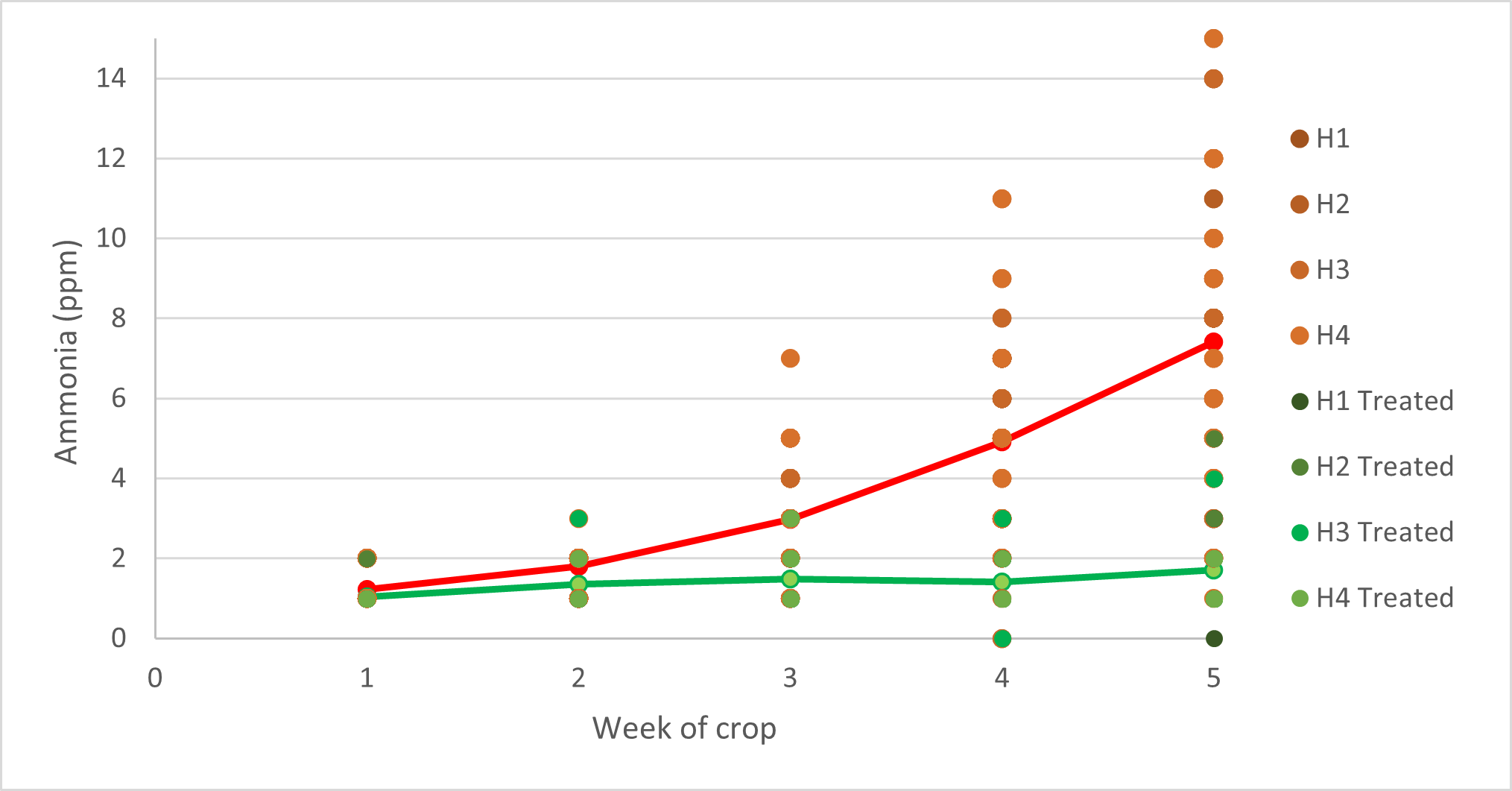
Using a hand-held ammonia meter (ToxiRAE II (PGM-1191) Ammonia Gas Detector), ammonia measurements were taken from the same place in the four houses each week. Data has been analysed from the farm which covers 16 crops pre-treatment and 9 crops post-treatment.

“As shown in Figure 1, ammonia readings appear to significantly increase during each successive week of growth for pre-treatment crops. However, there’s no significant increase in ammonia readings past the second week of each crop after the farm started treatment, with average ammonia readings not surpassing 1.80 parts per million (ppm),” says Elliott.

 lallemand chart 1

Figure 2 shows all houses had higher average ammonia readings pre-treatment compared to post-treatment, with house 1 seeing the largest average reduction effect between treatment groups: 9.13ppm pre-treatment as opposed to 1.78ppm post-treatment.
 lallemand chart 2


“The range of ammonia readings for all houses was higher during pre-treatment crops; with the highest reading being 15ppm during week 5. This compares to much lower ammonia readings in post-treatment crops; with 5ppm being the highest during week 5, representing a 67% reduction.”

“Overall, while the usual weekly increase in ammonia gas levels within poultry houses due to bird growth and litter accumulation is still mirrored, the average level each week following the use of the treatment protocol – Bactocell Drink and Lalfilm Pro – is significantly lower.

“This clearly shows the role the treatment programme could play in reducing excessive ammonia gas production from poultry houses,” adds Elliott.

As well as helping the environment, a reduction in ammonia is also beneficial for bird health and people in contact with poultry buildings. And, for those who are implementing ammonia reduction strategies, this data could provide an exciting insight into the role poultry microbiota has to play.

Pairing this approach with other strategies already in place for managing ammonia emissions – for example ensuring good ventilation and managing litter quality – could result in significant reductions.

“Keeping litter as dry as possible will help to reduce the development of ammonia gas, so make sure leaky drinkers are fixed and the house is properly heated and ventilated.

“The bird’s diet will also play a role in the formation of ammonia gas from the manure. Often this can happen if the bird isn’t properly breaking down and absorbing the protein in the feed. If you’re noticing ill-formed droppings, speak to your vet to identify whether it’s worth adjusting the diet to incorporate specific supplements which will promote good gut bacteria, helping the birds to utilise more of the available nutrients in the diet,” she says.

Poultry farm ammonia emissions are a complex issue in the industry, and with the growing demand for chicken meat providing diversification opportunities for a number of farmers, this will inevitably be an area of environmental focus going forwards. Although there is still a great deal of progress to be made, it’s worth exploring methods which have the potential to reduce emissions and can be easily implemented on-farm.   


Share. Facebook Twitter LinkedIn Email
Previous ArticleFeature: The search for antibiotic-free production
Next Article Keeping poultry sheds cool with high pressure fogging
Chloe Ryan

Editor of Poultry Business, Chloe has spent the past decade writing about the food industry from farming, through manufacturing, retail and foodservice. When not working, dog walking and reading biographies are her favourite hobbies.

Read Similar Stories

Production

Hatching a plan for turkey

June 12, 202611 Mins Read
Production

Trouw conference discusses sustainability

June 11, 20264 Mins Read
Broiler Production

UK poultry production surpasses 170,000 tonnes in April

June 5, 20262 Mins Read
Latest News

Comment: When the industry doesn’t tell its own story, someone else will

June 12, 2026

Hatching a plan for turkey

June 12, 2026

Trouw conference discusses sustainability

June 11, 2026
Sponsored Content

Take Control of Your Farm’s Biosecurity with Livetec

May 1, 2026

Address beta-mannans in broiler diets to optimise bird health and performance

April 1, 2026
© 2024 MA Agriculture Ltd, a Mark Allen Group company

Privacy Policy | Cookies Policy | Terms & Conditions

  • Farmers Weekly
  • AA Farmer
  • Farm Contractor
  • Pig World

Type above and press Enter to search. Press Esc to cancel.