

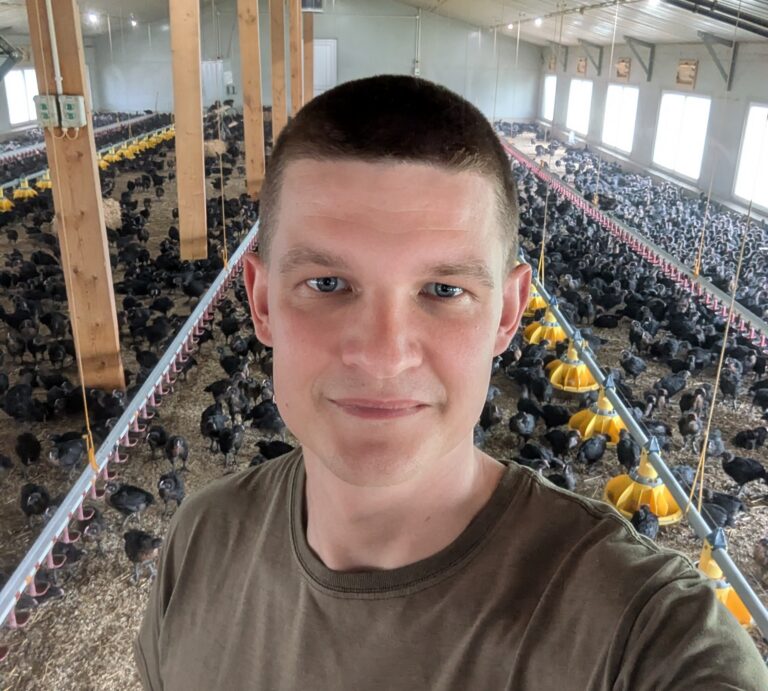
Lithuanian Eligijus Zenkovas has been named Unit Manager of the Year for his hard working, can-do attitude at Traditional Norfolk Poultry’s Wicklewood Farm. Michael Barker reports
Fate has a mischievous way of taking people’s lives in unexpected directions.
For Eligijus Zenkovas, being injured on Lithuanian military service was his sliding doors moment – it meant that suddenly, a planned career in the army was no longer in his future and he had to seek a new path. Not to be beaten down, he made the decision to move to the UK, and set his mind to finding something new to throw himself into: “I had always enjoyed farming because when I was a kid my mother and father kept some sheep,” he recalls. “I had wanted a longer career in the military, but the accident prevented me from going ahead with that. I never planned to work in farming, but when I arrived in the UK I started working with turkeys and that was the first time I’d worked with animals. I’m really enjoying it and now I want to progress within the industry.”
An individual that doesn’t take the easy route, Zenkovas arrived in the UK in 2020, just as the Covid pandemic hit. But getting a job at Wicklewood Farm, part of Traditional Norfolk Poultry (TNP), was the break he needed and it’s fair to say that he has truly thrown himself into the endeavour. Starting as a farm worker before being promoted to poultry farm manager in 2022, he benefited both from company training and his own desire to educate himself about his new subject matter as he set about being the best version of himself that he could be. “In the first few years the company helped me a lot in terms of introducing me to everything and explaining how to do it things,” he says. “They put me on courses for health and safety, poultry welfare, biosecurity and so on. But going forward, as I started working with the chicks more as a farm manager, I spent my free time on the internet reading about rearing, chicks brooding, the wider poultry business and how to build up farms. Step by step I was trying to improve, make less mistakes and make a good farm.”
It’s fair to say his hard work is paying off handsomely: in July Zenkovas was named Unit Manager of the Year at the 2026 National Egg & Poultry Awards in London. It was an award he couldn’t quite believe he had won: “At first I didn’t accept that it was true because there were some very strong finalists from some big companies,” he smiles. “But I was really excited when I heard my name and went up to collect the award. I feel really lucky.”
Now he has responsibility for the farm, Zenkovas has much more agency to run the unit as he sees fit, implementing his own ideas for improvements or innovations. He has shown over the past three years that he’s not afraid to try new things, or experiment with ideas that he’s read about that could work on the farm too.
Wicklewood has 60,000 chicks, with the farm taking them from one day old to 28 days in the case of non-organic, and 35 for organic. The site has eight sheds – four of which have been refurbished – with a mixture of free-range, corn-fed, organic and Norfolk Blacks. TNP boss Mark Gorton has also discussed the possibility of adding two new, modern sheds to the site in future.
Welfare is naturally a top priority, and Zenkovas stresses he puts a particular focus on the litter, clean water, and fresh feed. He is also big on providing stimulation for the birds, through toys, bottles, ropes, hanging CDs and so on. “Poultry welfare is the most important thing in the business,” he says. “I heard many good things from our poultry welfare officer, in terms of the fact that on my farm the birds had a zero podo score, and the officer also mentioned that the birds looked very calm. I try to spend more time with the birds inside the shed – it’s like they know me and I know them, so it’s better for us together!”
Currently, Wicklewood Farm is focused on chicken, but has also been trialling heritage turkey breeds on two mobile units, with a view to rolling out the premium breeds on a wider scale. A further trial has looked at grain-free feed, seeing how it compared with the standard feed to see if that’s a viable option for the future. “One shed was grain-free feed, and the other was normal, so we were looking at how that worked, how weights were going up, if they were drinking their water well and things like that,” he explains. “So I was monitoring them and passing all the information back to the office to see if we want to start ordering grain-free feed for the chickens in future.”
With TNP having been on the wrong end of avian flu in the past, there’s naturally a strong emphasis on biosecurity at the site, with strict protocols around visitors. In an additional move, Zenkovas took it upon himself to put decoy owls around the farm to scare pigeons, crows and small birds away from flying near the sheds, in the hope of further minimising the risk of disease ingress. “I read online that this was something you could do, so I tried it and within a couple of months we were seeing fewer and fewer crows around the farm,” he points out. That adds to CCTV cameras, motion sensors and other safeguards in place to minimise the unnecessary movement of people across the site.
From improving maintenance and tidiness to a strong focus on biosecurity, Zenkovas has really thrown himself into the job of taking the site to the next level, taking a huge amount of pride in the job. Understandably given the wider avian flu landscape, he names disease control as the biggest challenge of running a farm such as Wicklewood, ensuring that birds are as healthy as possible and have the environment to be strong.
Zekovas doesn’t hesitate when asked what he enjoys most about the job: “Being with the birds, and looking after them,” he says. “When I’m walking with them, I’m not just looking at them. I’m also looking out for their water, what they eat, mortalities in the sheds, their legs, and how they seem overall. Are they happy, chirping, running around and being active? I’m trying as much as possible for them to be happy, because if they’re happy then I’m happy and the whole flock will be nice and healthy.”
The 29-year-old has ambitions to continue his career within the industry, challenging himself to learn more and understand the newest production systems. He’s also keen to help others, imparting his knowledge and making any new arrivals feel at home. “If any new people arrive at my farm, I start by showing them from the control room to the shed, how the birds look, how you need to manage the farm step-by-step, from the ventilation to the heating systems and everything else,” he says. “And then from day three or four, I’ll start giving them tasks to do on their own. I’ll walk through the sheds with them and explain what was good and what could be better.”
Zenkovas works six days per week, with his partner Sandra also working one day per weekend on the farm. And when they are not on the farm, the couple have a staggering 14 cats, many of whom have been rescued. At the time of speaking to Poultry Business in August, he was planning a trip back to Lithuania to celebrate his 30th birthday, and he makes it a priority to return home to see his family during holiday periods. That sense of kinship with his homeland extends to helping friends back in Lithuania, who may not speak English quite as well, with CV writing or developing their computer skills.
He has undoubtedly not taken the easiest or most straightforward path in his life or career, but with an admirable ability to adapt to situations and apply himself to new subject matter, further success seems highly likely.