


Why one poultry farmer rethought illumination from the jungle up
When Robert Lanning of Devonshire Poultry talks about lighting, he doesn’t start with LEDs. He starts with trees.
“I’ve always tried to relate things back to nature,” he says. “If you look at chickens for what they are, not just what we’ve bred them into, they still come from jungle fowl. They evolved under tree canopies, with sunlight breaking through leaves. That’s never an even, white light.”
That way of thinking is what led the Devon poultry farmer to become, as far as he knows, the first in the UK to install NatureDynamics “Junglite” poultry lighting. Two years and 14 crops later, the system has now been ordered for three more sheds operated by his business.
Even light
Lanning first encountered the system while developing a new farm. At the time, other sheds operated by the business were still using older fluorescent tubes, which he describes as “fragile, inefficient, and forever breaking”.
“We were constantly replacing them,” he says. “So, we knew we wanted to do something different on the new site.”
It wasn’t efficiency alone that caught his attention. It was a challenge to a long-held assumption that in poultry housing even, uniform light is best.
“We put windows into chicken houses to get even light,” he explains. “We space them evenly, we try to remove shadows. But I actually think that’s the wrong way to look at it.”
His reasoning comes from outside the shed. “If you go to a free-range unit, what do you see? Trees. Shade. Not open, flat brightness. Chickens choose dappled light. They want darker areas as well as light ones.”
That observation was reinforced when he heard about the “jungle light” concept behind NatureDynamics. Rather than providing a single, flat spectrum, the system is designed to mimic the filtered, variable light environments birds evolved in. using carefully tuned combinations of red, green and blue wavelengths that change as birds age.
“When I had the idea explained to me, it just clicked,” Lanning says. “I couldn’t explain all the science at the time, but it made sense.”
First impressions: green sheds and calm birds
The first thing visitors notice is the colour.
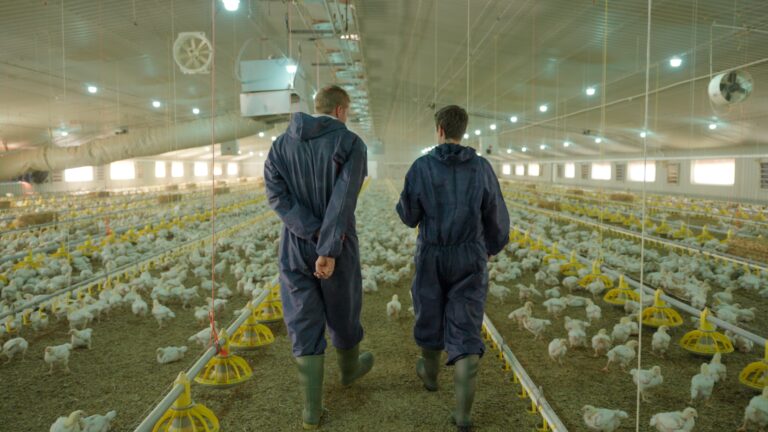
“When you look through the windows, everything’s green,” Lanning laughs. “When you’re doing checks, you think, ‘This is different.’”
The system was installed with blue-green-tinted ceiling lights, alongside additional LED lights mounted directly onto the feeder lines. These feeder-line lights were designed to create brighter zones around feed pans, with darker resting areas elsewhere, deliberately avoiding uniformity.
“They weren’t the cheapest lights to install,” Lanning admits. “But they did meet welfare grant criteria at the time, because of the different spectrum they provide. Unfortunately, we missed the grant window, but we went ahead anyway.”
The first crop under the new lighting were Ross 308s. Lanning remembers the difference clearly.
“The shed was noticeably calmer,” he says. “Anyone who walked in could see it straight away. The birds were settled, evenly spread, and you didn’t get that sudden panic movement when you entered.”
That calmness is something the system’s developers expected. Poultry perceive light very differently from humans: they are more sensitive to blue and red wavelengths and can also see ultraviolet-A light. They also respond to light non-visually through deep brain photoreceptors that influence circadian rhythms and stress responses.
“Humans judge light by what we see,” Lanning says. “But chickens see something completely different. That’s been a big learning point for me.”
The most striking moment came when a lighting specialist from the company, Erica, visited the farm to fine-tune the setup.
“She used an app on her phone,” Lanning recalls. “You can literally change the spectrum live.”
At one point, Erica decided the balance of colours wasn’t quite right.
“She said there was too much blue in the spectrum,” he explains. “So, she adjusted it.”
What happened next surprised Lanning. “The chickens reacted immediately. Honestly, instantly. Their behaviour changed as she moved the spectrum.
“It really showed me how powerful light is,” he says. “You could see them become more active with certain changes, then calmer with others.”
From a scientific perspective, that response is well documented. Longer wavelengths such as red tend to stimulate activity and exploration, particularly useful in early life when chicks need to find feed and water. Shorter wavelengths, including blue, have a calming effect and can reduce stress and fearful behaviour.
More activity, but not more chaos
As the lighting “recipes” were refined, Lanning noticed a shift in flock behaviour over subsequent crops.
“The second crop was more active, definitely,” he says. “But still calm. It wasn’t frantic or aggressive, just healthier movement.”
He is careful not to overstate performance gains. “When you’re dealing with large numbers of birds, every crop is different,” he says. “I can’t sit here and say we’re getting 30 grams more per bird. I don’t have that data.”
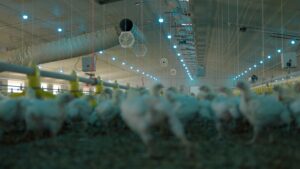
What he is confident about is welfare. “I think welfare has improved. We’ve seen better distribution, calmer birds, and fewer issues. That’s not always something you can capture neatly in figures.”
Lighting the feeder line
One of the more unusual elements of Lanning’s setup is the use of LED lights directly on the feeder lines.
The concept was simple: highlight the places where birds eat. “In nature, light breaks through the canopy, insects move, birds are drawn to it. So, we thought, why not do that around the feed pans?”
The feeder-line lights create localised brightness, while the rest of the shed remains relatively subdued. The lighting the feeder line is called Optient and was developed as a result of a huge research project with Tyson in the USA.
“You see more activity under the pans,” he says. “The birds are drawn to those areas.”
From a technical standpoint, the first-generation feeder-line lights provide a fixed output designed to create a light gradient, bright enough beneath the pan to encourage feeding and dust bathing, with darker areas elsewhere for rest.
“It all comes back to not making the shed one flat environment,” Lanning says. “Chickens don’t live like that.”
Seeing the science up close
Lanning’s confidence in the system was strengthened by a visit to the company’s research and development facilities in Eindhoven in the Netherlands, operated by Signify, the parent company behind the technology.
“I’ve been to R&D centres all over the world,” he says. “I’ve never seen anything like it.”
What struck him wasn’t poultry research alone, but demonstrations of how light affects perception more broadly.
“They showed how you can make meat look more appealing just by changing the light. Or how two identical dresses can look completely different colours until the lighting changes.
“If light can change how we see things that dramatically, imagine what it’s doing to chickens,” he says. “Especially when they see more of the spectrum than we do.”
That visit cemented his belief that lighting deserves far more attention than it traditionally receives.
Rolling it out further
After two years and 14 crops, Lanning has now ordered the system for three additional sheds from Signify’s UK distributor PW Maines.
“That’s the real test,” he says. “You don’t do that unless you’re convinced.”
Cost was a consideration. Compared with standard LED systems from the same supplier, Lanning estimates the NatureDynamics setup was around a third more expensive to install.
“But you can’t just look at the upfront cost,” he says. “You’ve got to look at welfare, behaviour, energy use, and how easy the system is to work with.”
One practical advantage is flexibility. The system operates wirelessly, allowing different areas of a shed to run different lighting programmes without rewiring.
“That makes life easier,” Lanning says. “And anything that genuinely makes farmers’ lives easier is worth looking at.”
A different way of thinking about light
Perhaps the most telling part of Lanning’s story is that, despite all the technology, his decision wasn’t driven by dashboards or spreadsheets.
“It’s easy to get obsessed with figures,” he says. “But birds aren’t spreadsheets.”
Instead, his verdict is based on what he sees every day.
“I walk into those sheds, and the birds just look settled,” he says. “They behave differently. They react differently. And to me, that matters.”
“For years, light’s just been something you switch on,” Lanning reflects. “Now I see it as part of the environment you’re creating for the bird.”