


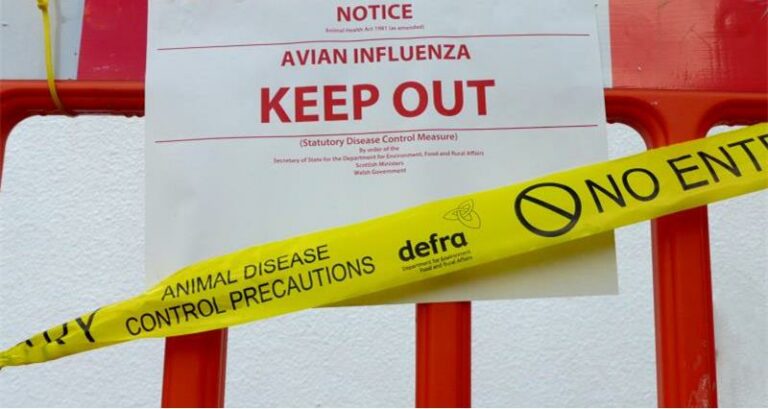
Defra has increased the risk of highly pathogenic avian influenza (HPAI) in wild birds in Great Britain from medium to high, following a rise in cases across the UK and Europe.
In its latest outbreak assessment, published on 6 November, Defra said 20 wild birds had tested positive for HPAI H5 between 1 October and 6 November, including 16 cases of H5N1 and four of H5N5.
The detections involved 13 species across 14 counties, with cases reported in England and Scotland. Six H5N1 cases were recorded in the first week of November alone.
There have also been four confirmed outbreaks in domestic poultry since the start of the 2026/27 season on 1 October. These comprised three H5N1 detections in poultry in England and Scotland, and one H5N5 outbreak in backyard poultry in Scotland.
The risk of HPAI H5 incursion into poultry where biosecurity is suboptimal has increased from low to medium, while the risk where stringent biosecurity is maintained has risen from very low to low.
Defra said the increase in wild bird infections, alongside continuing migration from areas of Europe where the virus is circulating, was increasing infection pressure on poultry.
It stressed the importance of maintaining stringent biosecurity to prevent direct or indirect contact between kept birds and wild birds, including contamination of feed, water, bedding, equipment and clothing.