


Five hundred years after the turkey is credited with first arriving in England, the British turkey industry is using its anniversary year to celebrate the bird’s remarkable place in British food culture – while encouraging consumers to bring the whole bird back to the Christmas table.
Pic credits Nello Fruncillo
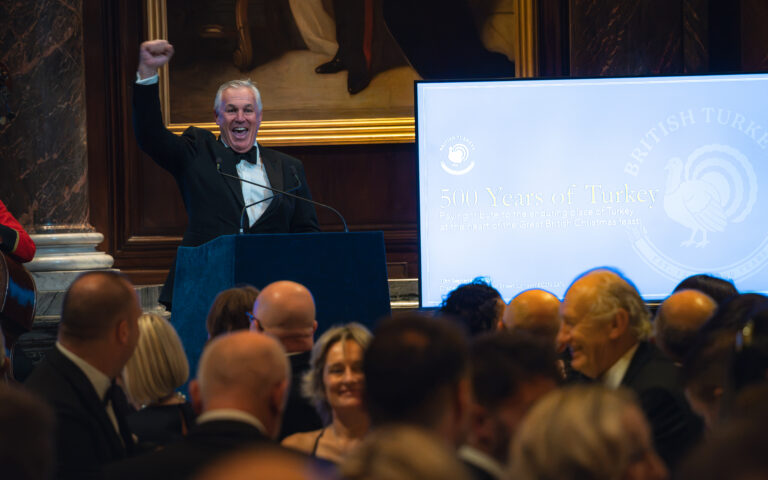
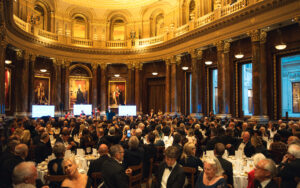
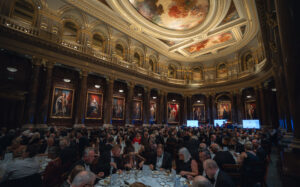
The campaign was given a suitably memorable launch at a 500 Years of British Turkey celebration dinner at the spectacular Drapers’ Hall in the City of London on 10 September.
It was an impressive setting for a bird with such a long history in Britain. Guests from across the turkey industry gathered for a champagne reception and three-course dinner, with a whole roast turkey on every table for guests to carve themselves.
Paul Kelly, managing director of Kelly Turkeys was the evening’s impressive MC, keeping proceedings moving with plenty of humour. There was a turkey gobble impression competition, a Cockney music singalong and plenty of celebration of the birds’ remarkable history.
The turkey’s arrival in England is generally attributed to Yorkshire merchant and navigator William Strickland, who is said to have brought six birds to Bristol in the 1520s.
Initially an expensive novelty, turkey gradually became associated with Christmas. It was eaten at Tudor feasts, with the birds originally walked by drovers from all over the country to the market in London. Those left unsold were walked home, their feet coated in tar to protect them for the journey, before being driven back to market the following year – a practice said to have inspired the phrase “tough old bird”.
Charles Dickens helped cement the association. In A Christmas Carol, published in 1843, Ebenezer Scrooge sends the Cratchit family a large turkey for Christmas, helping to establish the bird as a symbol of generosity and the Victorian festive feast.
The modern turkey industry emerged much later, developing from a small-scale, seasonal enterprise into a commercial industry as advances in breeding, nutrition, disease control and production systems enabled much larger-scale production.
That expansion created the turkey industry familiar today – but demand for the whole bird has subsequently come under pressure as household sizes, shopping habits and Christmas traditions have changed.
That is why the 500th anniversary is being treated as more than a historical milestone.
British Turkey has partnered with television chef Matt Tebbutt for its Winner! Winner! Turkey Dinner! campaign, designed to persuade consumers to rediscover the whole roast turkey. Tebbutt has developed recipes ranging from a traditional roast turkey and gravy to an Asian-style pulled turkey noodle salad using leftovers.
The campaign also aims to tackle some of the practical barriers associated with buying and cooking a whole bird, with advice on preparation, carving, cost-saving and making use of leftovers.
That was demonstrated at Drapers’ Hall. Rather than having turkey served up as individual portions, guests were handed a whole bird and expected to get involved.
That communal element is important. The campaign is attempting to reconnect consumers with the experience of buying, cooking, carving and sharing a whole bird.
The campaign is being supported by a broad group of British producers and organisations, including Bernard Matthews, 2 Sisters Agriculture, Avara Foods, Hockenhull Turkeys, Kelly Turkeys, Gressingham Foods, Capestone Poultry, Traditional Norfolk Poultry, the Traditional Farm Fresh Turkey Association, Anglian Turkey Association, Usk Vale Poultry and Farm Hatcheries.
Five hundred years after its arrival, the challenge is to ensure the whole bird still feels relevant to the next generation of British Christmas shoppers.