


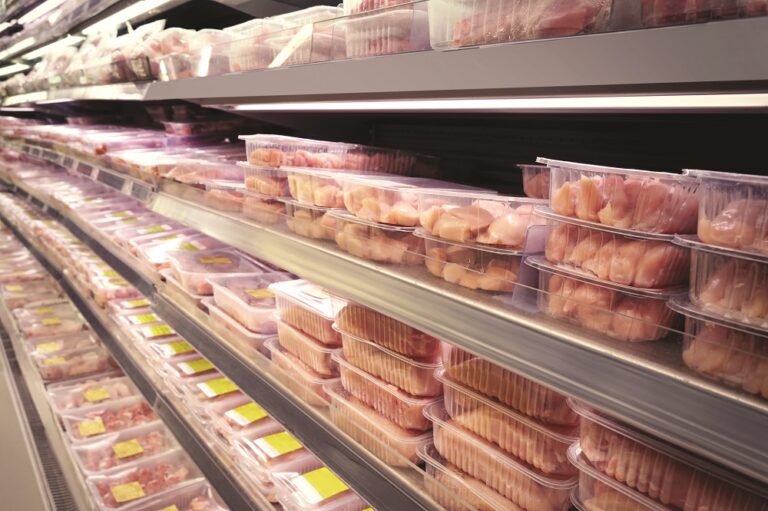
Supermarket meat prices continued to soften during July, but chicken was the only major protein category to record an overall increase, according to the latest inflation report from the Association of Independent Meat Suppliers (AIMS).
Across beef, lamb, pork and chicken, average supermarket prices fell by 0.16% during the month, continuing the downward trend seen in June (0.41%). However, chicken prices rose by 0.64%.
Tony Goodger, head of communications at AIMS, said demand for both beef and chicken had been boosted by the combination of hot weather and England’s progress in the World Cup.
“Beef, which in June fell by 2.26%, has largely stabilised with a marginal fall of just 0.15%, while chicken prices increased by 0.64%,” he said.
“It is likely that the combination of England’s progress in the World Cup and the hot weather has driven demand for beef and chicken for barbecues and summer salads.”
Goodger warned that while favourable weather had supported sales, higher production costs were likely to feed through into retail prices across all meat categories later this year and into 2027.
Within the chicken category, diced British chicken breast recorded one of the strongest price increases, rising 3.07% (£0.27/kg) during the month and 8.82% (£0.74/kg) year-on-year.
Goodger said the wider range of pack sizes now available – from 300g up to 2kg – was giving consumers greater choice but may also be contributing to higher average prices.
“Other input costs such as packaging, labelling and production are broadly the same regardless of pack size, which, in my view, has contributed to the increase,” he said.
Elsewhere, AIMS said beef prices had largely stabilised after June’s sharp decline, while lamb remained the only meat category showing positive annual inflation, up 5.53% (£0.91/kg).
Goodger also highlighted changing consumer buying habits in the pork sector. Although lower-priced pork is often seen as an alternative to beef and lamb, pork loin steaks fell 3.21% during the month and were down 17.84% year-on-year. He suggested consumers may instead be favouring slow-cooked pork shoulder, which has become increasingly popular for barbecues.
Looking ahead, Goodger expects supermarkets to compete aggressively for shoppers as the summer holiday period gives way to the return to school and the run-up to Christmas.
“With meat and poultry accounting for a significant proportion of the weekly shopping bill, I expect to see fierce price competition and more aggressive promotion of bundle deals over the coming months,” he said.