


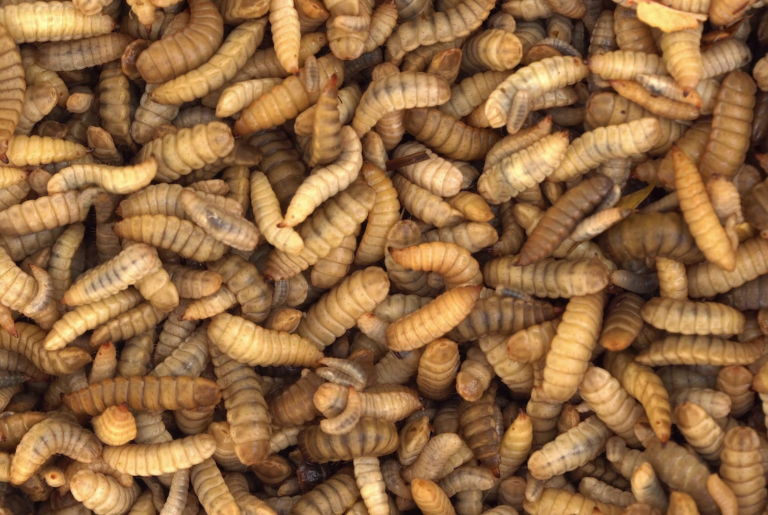
Scattering black soldier fly larvae (BSFL) onto broiler house litter could offer poultry producers an immediate, cost‑effective welfare uplift.
That’s according to new research from Nottingham Trent University (NTU) and insect‑technology company Flybox, who argue the findings could prove invaluable at a time when the UK sector faces growing pressure to demonstrate higher welfare without adding significant cost.
The findings, which will be presented at the World’s Poultry Congress in Toronto on 13-17 July and at the WPSA UK Spring Meeting on 22-23 April in Manchester, indicate that insects stimulate natural foraging and activity, even in fully indoor systems.
A peer‑reviewed paper underpinning the work has been published in the journal Applied Animal Behaviour Science.
Across multiple NTU trials, researchers found that scattering BSFL significantly increases active behaviours such as foraging, walking, running, preening and dustbathing in fast‑growing broilers. It also boosts foraging motivation even on days when no insects are offered, indicating a lasting behavioural benefit.
The research also found that it does not negatively affect growth rate, feed intake, FCR or gut development, making it commercially practical.
Lead author Chris Onuoha, a PhD researcher in Nottingham Trent University’s School of Animal, Rural and Environmental Sciences, said: “Our research shows that something as simple as scattering insect larvae can meaningfully change how broilers interact with their environment. We observed more natural foraging, more movement, and more engagement – exactly the kinds of behaviours linked to better welfare.”
Flybox CFO Thomas Stringer added: “Chickens are natural foragers. By supplying insects in a scalable, biosecure way, we enable producers to enhance welfare with minimal disruption.”
NTU and Flybox are now encouraging integrators, retailers and producers to explore commercial‑scale trials of BSFL enrichment.