


Poultry News
  • Production
    • Broiler Production
    • Ducks
    • Egg Production
    • Game
    • Hatching
    • Housing
    • Turkeys
  • Processing
  • Business & Politics
    • Business
    • Economics
    • EU & Politics
    • Marketing
    • People
    • Training & Education
  • Welfare
    • Environment
    • Food Safety
    • Vet & Medication
    • Welfare
  • Feed
  • Genetics
  • New Products
  • Magazines
    • February 2026
    • January 2026
    • December 2025
    • November 2025
    • October 2025
    • September 2025
    • 2025 Buildings supplement
    • August 2025
    • 2025 Poultry Health supplement
    • July 2025
    • 2025 National Egg and Poultry Awards finalists supplement
    • June 2025
    • 2025 Innovation supplement
    • May 2025
    • April 2025
    • March 2025
    • 2025 Feed and Nutrition supplement
    • February 2025
    • January 2025
    • December 2024
    • November 2024
    • October 2024
    • September 2024
    • 2024 Building for the Future supplement
    • August 2024
    • 2024 Poultry Health supplement
    • July 2024
    • 2024 National Egg and Poultry Awards finalists supplement
    • June 2024
    • 2024 Innovation supplement
    • Pig & Poultry Fair 2024
    • May 2024
    • April 2024
    • March 2024
    • February 2024
    • January 2024
    • December 2023
    • November 2023
    • Processing Equipment Supplement – Nov 2023
    • October 2023
    • Building Supplement – Sept 2023
    • September 2023
  • Jobs
    • Browse Jobs
    • Post a Job
    • Manage Jobs
  • Events
    • National Egg and Poultry Awards
    • Poultry Fair
    • Webinars
Twitter LinkedIn
  • FREE Email Newsletters
  • About Us
  • Advertise
  • Subscribe
  • Contact Us
Twitter LinkedIn
Podcast
Poultry News
  • Production
    • Broiler Production
    • Ducks
    • Egg Production
    • Game
    • Hatching
    • Housing
    • Turkeys
  • Processing
  • Business & Politics
    • Business
    • Economics
    • EU & Politics
    • Marketing
    • People
    • Training & Education
  • Welfare
    • Environment
    • Food Safety
    • Vet & Medication
    • Welfare
  • Feed
  • Genetics
  • New Products
  • Magazines
    1. February 2026
    2. January 2026
    3. December 2025
    4. November 2025
    5. October 2025
    6. September 2025
    7. 2025 Buildings supplement
    8. August 2025
    9. 2025 Poultry Health supplement
    10. July 2025
    11. 2025 National Egg and Poultry Awards finalists supplement
    12. June 2025
    13. 2025 Innovation supplement
    14. May 2025
    15. April 2025
    16. March 2025
    17. 2025 Feed and Nutrition supplement
    18. February 2025
    19. January 2025
    20. December 2024
    21. November 2024
    22. October 2024
    23. September 2024
    24. 2024 Building for the Future supplement
    25. August 2024
    26. 2024 Poultry Health supplement
    27. July 2024
    28. 2024 National Egg and Poultry Awards finalists supplement
    29. June 2024
    30. 2024 Innovation supplement
    31. Pig & Poultry Fair 2024
    32. May 2024
    33. April 2024
    34. March 2024
    35. February 2024
    36. January 2024
    37. December 2023
    38. November 2023
    39. Processing Equipment Supplement – Nov 2023
    40. October 2023
    41. Building Supplement – Sept 2023
    42. September 2023
    Featured

    Poultry Business – February 2026 issue out now

    By Chloe RyanFebruary 11, 2026
    Recent

    Poultry Business – February 2026 issue out now

    February 11, 2026

    Poultry Business – January 2026 issue out now

    January 13, 2026

    Poultry Business – December 2025 issue out now

    December 8, 2025
  • Jobs
    • Browse Jobs
    • Post a Job
    • Manage Jobs
  • Events
    • National Egg and Poultry Awards
    • Poultry Fair
    • Webinars
Twitter LinkedIn
Poultry News
Health & Welfare

New approach to layer performance

Chloe RyanBy Chloe RyanOctober 13, 20254 Mins Read
Facebook Twitter LinkedIn Email
Share
Facebook Twitter LinkedIn Email

Training sessions highlight how body-condition assessment can help sustain persistency and maximise egg numbers.

With demand for eggs increasing, the pressure is on the industry to increase productivity. “This will either be achieved by more birds, or more eggs per bird,” said Cargill technical application specialist Luke Barnard.

Speaking to producers and trade representatives at the Cargill poultry workshops this summer, he highlighted new technology that can provide a fast, non-invasive assessment of the body composition of the bird. With a proven correlation between body composition and layer persistency, this data can be used to pre-empt problems, keep birds on target and achieve efficient layer persistency with increased egg numbers per bird.

“It’s important to take a holistic approach to increasing egg production by taking advantage of breeding advances, good nutrition and management knowledge that encompasses the ‘ideal’ lighting, environment and health care,” he said.

“If we want birds to lay for longer and produce more eggs, we need to set them up for success,” he said. “This means investing more in the rearing period and getting the birds as robust as possible.”

Cargill has researched the impact of nutrition on laying persistency and compared diets with varying levels and combinations of dietary energy and oil content. Results found that egg number could be manipulated through the diet. Data also shows a lower rate of decline in egg numbers where energy was reduced but the oil content of the ration remained high.
“The diet will affect body composition, hormone pathways and liver function. All these factors impact egg production,” said Barnard, adding that hens with an optimal body condition score have been found to have an extended production cycle.

“We know body composition is a long-term predictor of laying persistency and that body composition at 20 weeks old correlates with egg production between weeks 63 and 75. So by measuring body composition we can fine-tune inputs, particularly diet, to improve long-term egg production.”

One indicator of body composition is weight of fat pad. “The two are strongly correlated, and an over-developed fat pad be detrimental to long-term egg production and optimal liver function,” added Barnard.

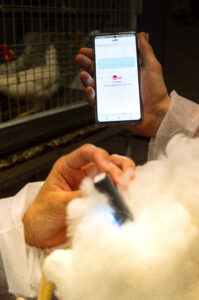
The new measurement tool Reveal Layers, developed by Cargill, uses a non-invasive handheld infrared monitor to scan the fat pads in rearers and layers. Results are logged directly via Bluetooth to a mobile device and results are assessed and benchmarked against the optimum body score range for their age.

Cargill has collated a large database to calibrate body condition against productivity relative to hen age and colour. It has used this and in-depth knowledge to develop accurate algorithms. This information allows for corrective measures to be taken when flock data deviates from the expectation.

“We recommend scanning fat pad weights in a random group of between 50 and 100 birds every four to six weeks,” he said. “Reveal Layers is recommended in flocks of brown or white birds between 15 and 75 weeks old.

“The data provides producers and nutritionists with immediate access to body composition assessments of their hens. And we compare the results with Cargill’s benchmarks and the flock’s data to suggest nutritional changes and management changes to support future performance,” added Barnard.

“These decisions are in real-time and help to support the flock’s long-term performance. The tool gives us a new window into the birds’ condition and potential performance and provides insights that were not previously obtainable.”

Barnard pointed out that while a strong correlation is found between fat pad weight and body composition and productivity, there is no strong correlation between body weight and body composition.

Cargill has shown a difference of 80g in fat pad weight among birds of the same body weight, and a range in body weights of 700g among birds with the same fat pad weight.

“Just because the birds look the same, their body composition and egg production potential may be very different,” he added.

“But by optimising body condition, the hen’s productive period can be extended and egg production increased, making older flocks more viable. We could see a potential gain of between 10 and 20 eggs per bird at the same age of cull or an extended laying period. This gives more eggs and a lower annual pullet replacement cost, which can result in significant economic and environmental benefits for producers.”

Share. Facebook Twitter LinkedIn Email
Previous ArticleComment: Letter from the Eurostar
Next Article Poultry Business – October 2025 issue out now
Chloe Ryan

Editor of Poultry Business, Chloe has spent the past decade writing about the food industry from farming, through manufacturing, retail and foodservice. When not working, dog walking and reading biographies are her favourite hobbies.

Read Similar Stories

Health & Welfare

Focus on vets: Taking the temperature

February 10, 20268 Mins Read
Health & Welfare

Free-range egg producers urged to invest in disease mitigation measures

February 2, 20263 Mins Read
Health & Welfare

Avian flu cases reach 93

February 2, 20262 Mins Read
Latest News

Sector resilience in focus at NFU conference poultry session

February 27, 2026

AIMS calls for immediate reform of UK–EU SPS system

February 26, 2026

EU poultry sector calls for precautionary suspension of imports from China

February 25, 2026
Sponsored Content

Stay one step ahead of outbreaks

December 3, 2025

Can Aviance improve production and shell quality in full laying cycle?

October 1, 2025
© 2024 MA Agriculture Ltd, a Mark Allen Group company

Privacy Policy | Cookies Policy | Terms & Conditions

  • Farmers Weekly
  • AA Farmer
  • Farm Contractor
  • Pig World

Type above and press Enter to search. Press Esc to cancel.