


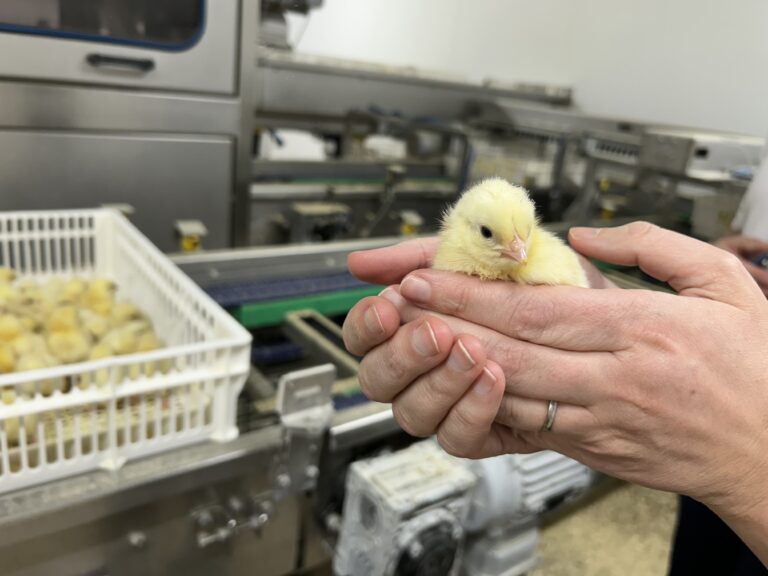
How the hatchery is scaling up capacity while investing in technology that aims to improve broiler performance
Early morning on a cold Boston morning and the team at Annyalla Chicks (UK) is already deep into another hatch day. Trolleys hum in large rooms, air-handling units rumble overhead, and the unmistakable sound of new chicks fills the corridors. For David Little, the hatchery manager and Tom Woolman, customer services manager, the early start is simply part of running operations at the expanding Lincolnshire site,
Annyalla’s Butterwick hatchery is a modern, spacious and well organised facility, redeveloped from a former Marshalls vegetable packing site on the outskirts of the Lincolnshire town.
It is the first and only hatchery in the UK to use HatchTech’s HatchCare system that provides feed and water to chicks as soon as they hatch, and such is the demand for the chicks, a major expansion is beginning next year.
“Annyalla purchased the site in 2017 and started the install soon after,” says Little, who previously worked for Moy Park in Northern Ireland.
Since then, the Boston operation has grown into a significant supplier of the HatchCare chicks, which sell for a 2p per chick premium, based on metrics including more even growth, early weights higher, and welfare indicators improved.
Supply chain
A large proportion of Annyalla’s egg supply comes from within its own network. “Most of our eggs come from company-owned farms or contractors, and then the balance is made up from egg purchases,” Little says.
The firm is mid-way through a significant expansion of this internal supply chain. “The next 18 months, we’ve got five new company farms coming on… four of those are breeder farms and one is a broiler farm,” he adds. This reduces risk, stabilises planning, and improves consistency, all of which are critical in a sector where disease risk can rapidly disrupt supply.
It also gives the team far greater flexibility when demand shifts. Woolman explains the benefit: “If, for whatever reason, we’ve hatched down and we’re short of chicks, then we can make sure the customer gets what they want.” And the converse is true too: “You’re not having to essentially give away chicks if you’ve got excess.”
With customers spread from Cheshire to Somerset and into Norfolk, so logistics at Annyalla are a finely tuned operation.
Customers
Annyalla’s customer base is diverse. From independent growers to major specialist processors, the hatchery supplies a broad range of farm types across the UK.
As Woolman explains: “We will send chicks all over the country.” The routes are nationwide: “Wrexham across the country… Cheshire, down to Welshpool, Carlisle, Somerset”. As well as the Boston hatchery, Annyalla also supplies chicks across the UK from its hatchery in Wrexham.
What stands out is that the company operates outside the fully integrated model that dominates much of the British poultry sector. That independence gives customers something they rarely get elsewhere: choice. “A lot of poultry farmers… had an awful lot of choice stripped away from them… choice of who they supply, who they get their feed from, choice of breed,” Woolman says. Being able to choose between standard and HatchCare chicks is appealing to many farmers, he believes.
Biosecurity
As you would expect, the site’s layout reflects strict biosecurity discipline.
“We have a keypad system and every member of staff has a unique code,” Little explains. “We split staff: egg side and chick side.”
And once staff shower in, movement is tightly managed. “We have face recognition technology and after that there’s a hand wash and foot-dip station,” Little says.
Expansion
When the hatchery first opened, output was around 500,000 chicks per week. “We quickly installed a few more setters and that went up to 900,000 per week towards the end of ‘18 and 2019,” says Little. “Demand was that good… you’re always trying to think ahead, how to get the most out of these machines.”
Growth continued after covid. “We increased quickly… to just over 1 million,” he explains. “We can now go up to 1.8 million due to hatching capacity, which we have done.”
The installation early next year of additional setters will push that ceiling significantly higher. “We’re starting in January, which will bring us to upwards near two million chicks per week,” Little notes. And that’s only phase one.
Planning permission is already in to build an extension to the existing footprint. “We will be able to produce on average about 2.7 million, but we could go up to 3 or 3.1 million. We’ll have the capacity.”
HatchCare
What is clear is the appeal to customers of the HatchCare system, which provides newly hatched chicks with immediate access to feed, water and light.
Watching a batch ready for dispatch, the atmosphere is surprisingly peaceful. “You’ll see they are calm… very calm,” Little notes, and it’s true: chicks sit quietly under the warm airflow, already hydrated and fed.
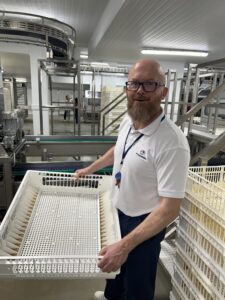
“For me that’s the future,” Little says. “They’ve got access to water, they’ve got access to feed, and actually you walk into the machine, you might as well not be there. They just sit calm.”
It was a learning curve even for experienced hatchery staff. “It took me a few weeks just to get used to this bird. Farmers used to phone up going, what’s wrong with these chickens? They’re not moving.”
But once customers saw the results, demand surged. “Once people got used to them, the demand was very high.”
The Boston team has run extensive trials comparing identical flock batches with and without early feeding. “We were seeing 14% difference in weight on the chicks. It showed how much the chicks were dehydrated in a normal hatcher.” Chicks are visibly hydrated and steady on their feet straight away.
Expansion
Next year’s expansion will include the newest HatchTech setters, which lengthen the preheat period from hours to days.
“Effectively what that means is instead of having a 21-day incubation period, they’ve got a 24-day incubation period,” says Woolman. “You end up gently, gently getting all of the eggs to the same physiological state.”
Little is an advocate for long preheat periods after trialling the effects. “We preheat the eggs for 22 hours, and you can see a benefit right across the board,” he says.
Automation
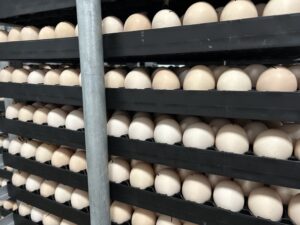
Walking through the egg room, Little points out equipment that was state-of-the-art when installed and makes use of as much automation as possible.
“We destack the eggs automatically, they go through heartbeat candling, and pick up only the fertile eggs,” he explains. Boston was the first UK hatchery to install that system, and another firm only adopted it after seeing it in action.
“The whole point of the HatchCare process is minimal handling,” Little says. “The chicks hatch out into the basket they’re in… and stay in that basket until they go to the farm.”
The market agrees. “At the moment we’re oversubscribed,” Woolman says. “That’s why we’re continuing to expand.”
The business remains family-owned, something both Woolman and Little value. Decisions are quick and pragmatic and grounded in trust. As Woolman puts it: “What I really like about the business… you pick up the phone and say, ‘What are we doing with this?’ and just go, ‘Yep, we’ll do it.’”
“The owners, the Mawer family, are spending £15 million on capex this year… it’s really encouraging,” Woolman notes.
Their enthusiasm is palpable. “I’m excited to see it… I think it’s the future,” Little. “We are seeing benefits right across the board.”