

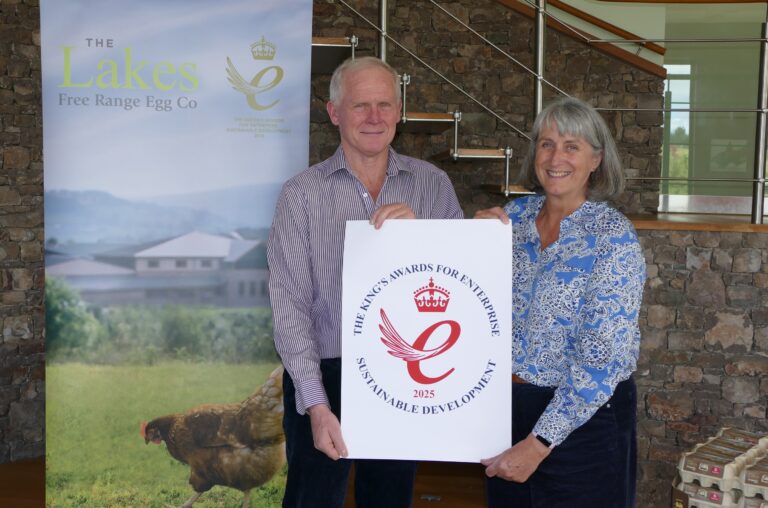
The Lakes Free Range Egg Company (The Lakes) has been presented with a King’s Award for Sustainable Development.
Following a formal reception at Windsor Castle last year, the official presentation of the King’s Award for Enterprise in the Sustainable Development category was made to David and Helen Brass and their team at The Lakes’ packing centre and headquarters in Stainton. Representing Cumbria’s Lord Lieutenant at the presentation were Deputy Lieutenants Bryan Gray and Ian Brown.
The King’s Awards for Enterprise honour exceptional achievements made by UK businesses.
David Brass said, “Putting this award into perspective, fewer than 200 companies nationwide received awards across four categories this year, and only 27 of those were for sustainable development. We were told that this is the most challenging category in which to be recognised, so to receive it twice, is a huge accolade to the work of our entire team. This means everyone from our farmer suppliers who all have biodiversity action plans on their farms, to our farm and factory colleagues and our despatch team.
“Our first award was the Queen’s Award in 2018, when the company celebrated its 21st anniversary, and this second award was announced last year. No other egg producer or packer has achieved this level of recognition, and we are immensely proud of both the achievement and the team that helped us accomplish it.”
In presenting the award, Cumbria’s Deputy Lieutenant Bryan Gray said, “This Sustainable Development Award sets an extremely high bar to achieve, endorsed by the fact that only 27 awards have been presented this year. It is a very exclusive club – and one which His Majesty King Charles is keen to support. It is a particularly outstanding achievement to receive recognition in this category for a second time and is a testament to setting exacting standards and pursuing excellence at all times, alongside good leadership, and a talented team.”
The Lakes was founded in 1997 by David and Helen Brass.
From inception, they have always believed that planting trees improves the welfare of free-range hens. When they began, no industry standards existed, so they led the way.
By planting native trees and shrubs on their ranges – and those of their producers – the company has enhanced wildlife habitats and biodiversity, significantly increasing both the variety and number of species recorded on farms.