


Poultry News
  • Production
    • Broiler Production
    • Ducks
    • Egg Production
    • Game
    • Hatching
    • Housing
    • Turkeys
  • Processing
  • Business & Politics
    • Business
    • Economics
    • EU & Politics
    • Marketing
    • People
    • Training & Education
  • Welfare
    • Environment
    • Food Safety
    • Vet & Medication
    • Welfare
  • Feed
  • Genetics
  • New Products
  • Magazines
    • September 2026
    • 2026 Buildings supplement
    • August 2026
    • 2026 Health supplement
    • July 2026
    • 2026 National Egg and Poultry Awards finalists supplement
    • June 2026
    • 2026 Innovation supplement
    • 2026 British Pig & Poultry Fair guide
    • May 2026
    • March 2026
    • 2026 Feed & Nutrition supplement
    • February 2026
    • January 2026
    • December 2025
    • November 2025
    • October 2025
    • September 2025
    • 2025 Buildings supplement
    • August 2025
    • 2025 Poultry Health supplement
    • July 2025
    • 2025 National Egg and Poultry Awards finalists supplement
    • June 2025
    • 2025 Innovation supplement
    • May 2025
    • April 2025
    • March 2025
    • 2025 Feed and Nutrition supplement
    • February 2025
    • January 2025
    • December 2024
    • November 2024
    • October 2024
    • September 2024
    • 2024 Building for the Future supplement
    • August 2024
    • 2024 Poultry Health supplement
    • July 2024
    • 2024 National Egg and Poultry Awards finalists supplement
    • June 2024
    • 2024 Innovation supplement
    • Pig & Poultry Fair 2024
    • May 2024
    • April 2024
    • March 2024
    • February 2024
    • January 2024
    • December 2023
    • November 2023
    • Processing Equipment Supplement – Nov 2023
    • October 2023
    • Building Supplement – Sept 2023
    • September 2023
  • Jobs
    • Browse Jobs
    • Post a Job
    • Manage Jobs
  • Events
    • National Egg and Poultry Awards
    • Poultry Fair
    • Webinars
Twitter LinkedIn
  • FREE Email Newsletters
  • About Us
  • Advertise
  • Subscribe
  • Contact Us
Twitter LinkedIn
Podcast
Poultry News
  • Production
    • Broiler Production
    • Ducks
    • Egg Production
    • Game
    • Hatching
    • Housing
    • Turkeys
  • Processing
  • Business & Politics
    • Business
    • Economics
    • EU & Politics
    • Marketing
    • People
    • Training & Education
  • Welfare
    • Environment
    • Food Safety
    • Vet & Medication
    • Welfare
  • Feed
  • Genetics
  • New Products
  • Magazines
    1. September 2026
    2. 2026 Buildings supplement
    3. August 2026
    4. 2026 Health supplement
    5. July 2026
    6. 2026 National Egg and Poultry Awards finalists supplement
    7. June 2026
    8. 2026 Innovation supplement
    9. 2026 British Pig & Poultry Fair guide
    10. May 2026
    11. March 2026
    12. 2026 Feed & Nutrition supplement
    13. February 2026
    14. January 2026
    15. December 2025
    16. November 2025
    17. October 2025
    18. September 2025
    19. 2025 Buildings supplement
    20. August 2025
    21. 2025 Poultry Health supplement
    22. July 2025
    23. 2025 National Egg and Poultry Awards finalists supplement
    24. June 2025
    25. 2025 Innovation supplement
    26. May 2025
    27. April 2025
    28. March 2025
    29. 2025 Feed and Nutrition supplement
    30. February 2025
    31. January 2025
    32. December 2024
    33. November 2024
    34. October 2024
    35. September 2024
    36. 2024 Building for the Future supplement
    37. August 2024
    38. 2024 Poultry Health supplement
    39. July 2024
    40. 2024 National Egg and Poultry Awards finalists supplement
    41. June 2024
    42. 2024 Innovation supplement
    43. Pig & Poultry Fair 2024
    44. May 2024
    45. April 2024
    46. March 2024
    47. February 2024
    48. January 2024
    49. December 2023
    50. November 2023
    51. Processing Equipment Supplement – Nov 2023
    52. October 2023
    53. Building Supplement – Sept 2023
    54. September 2023
    Featured

    Poultry Business – September 2026 issue out now

    By Chloe RyanSeptember 9, 2026
    Recent

    Poultry Business – September 2026 issue out now

    September 9, 2026

    Poultry Business – 2026 Buildings supplement out now

    September 9, 2026

    Poultry Business – August 2026 issue out now

    August 13, 2026
  • Jobs
    • Browse Jobs
    • Post a Job
    • Manage Jobs
  • Events
    • National Egg and Poultry Awards
    • Poultry Fair
    • Webinars
Twitter LinkedIn
Poultry News
Egg Production

Technical advice: Meeting the demand for larger eggs

Chloe RyanBy Chloe RyanJanuary 17, 20194 Mins Read
Facebook Twitter LinkedIn Email
Share
Facebook Twitter LinkedIn Email

How producers can increase the size of their eggs and boost the bottom line.

By Karen Wright

The UK egg market is seeing a surge in the demand for bigger eggs and a widening gap in prices paid to producers for very large and large eggs. This is an incentive to producers to increase egg size, but it also raises challenges. Feed and management strategies can be used to manipulate egg size in laying hens.

But there are a number of factors involved, says Cargill’s technical poultry adviser Daniel Palcu. “Management factors, such as controlling the rearing phase, pullet weight, light and temperature control in the laying phase, and disease protocols, must be tip top,” he says. “But nutrition plays a major part, especially lysine and energy levels in the feed.”

Some producers are looking at adjusting diets to achieve heavier eggs that fall in to the very large and large categories. “Reformulating diets and adjusting amino acid and energy levels will influence egg size,” says Palcu. “We have achieved this in the past when demand has been stronger for smaller eggs, and diets have been adjusted, typically by reducing lysine levels, to achieve this.”

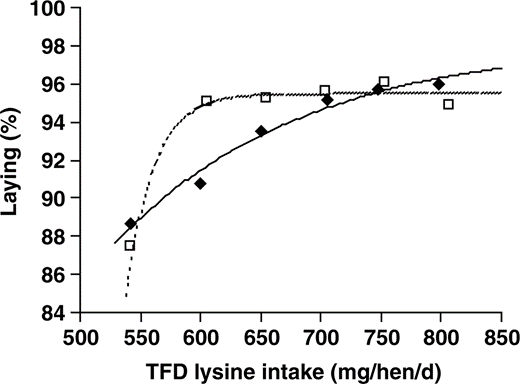
A study by Bonekamp et al. (2010) in Poultry Science looked at the effect of different lysine (Lys) levels on egg production and egg mass for light (white Lohmann LSL Classic) and heavy (Lohmann Brown Classic) laying hens from 24 to 60 weeks of age. Twelve treatment groups consisted of 47 layers each, divided over the layer house. They were fed a diet with six dietary amino acid intake levels evenly spread from 550mg to 800mg of true fecal digestible (TFD) lysine per hen per day.
large eggs chart 1

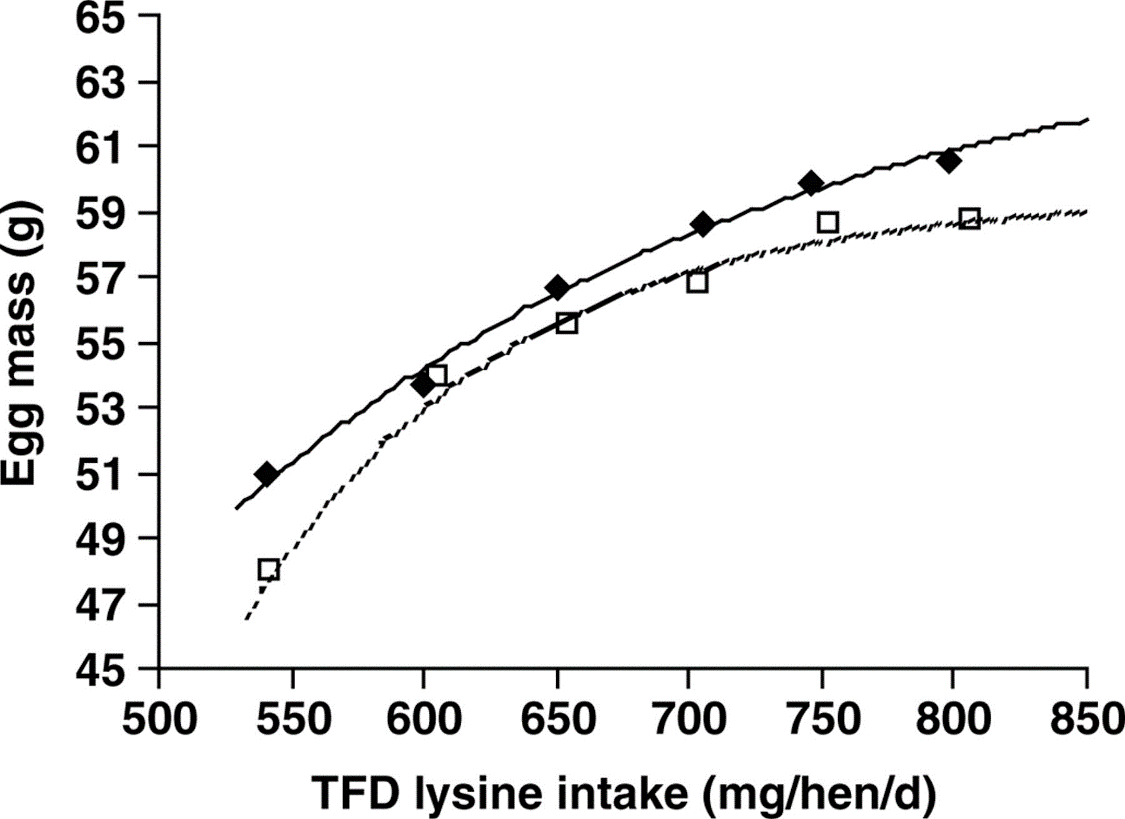
Other amino acids were included in fixed ratios and diets were restricted to maintain a feed intake of 110g per hen for heavy hens and 100g per hen for light hens to achieve the required balanced protein supply. The results are shown in Figures 1 and 2. 

The results of this trial show that a daily intake of 600mg TFD Lys is sufficient to optimise the laying percentage of white light hens, whereas for brown heavy hens no optimum was reached with the current range of TFD Lys levels. This demonstrates the different levels between breeds, but of significance to UK producers, it shows that the TFD Lys level for optimal laying percentage is higher than the current tested 800 mg/hen/ day TFD Lys intake. Results for laying % within the lower TFD Lys treatments suggest that levels of 600mg TFD Lys for white light layers is risky. 
large eggs chart 2

Egg mass improved up to the highest tested TFD Lys level of 800mg for both breeds (Figure 2), suggesting that these higher rates of inclusion will help producers maximise egg weight. The slope of the curves in both Figure 1 and 2 indicate that the required TFD Lys level for maximum performance is lower for white than for brown hens. “This illustrates that the breed has an effect on egg size, but also, that in each case, lysine levels will influence egg size and weight,” adds Palcu.

Fine-tuning energy There is a correlation between energy levels and egg size. “But it doesn’t mean that more is better,” he says. “Energy is the most expensive ingredient in the diet – therefore more accurate rationing will justify its use.” “Lysine and energy levels have a bearing on egg size, and producers can use these. We should also consider other nutritional factors when we are looking to increase egg size including the feed particle size, as this can influence feed consumption and therefore affect the egg weight.

Feed form is important too – pellet and crumble tend to increase egg weight – along with other amino acids, particularly the methionine levels, linoleic acid and total added oil. “From research, we know that by following specific nutritional recommendations for increasing egg weight, such as those for lysine and energy, we can increase egg weight by at least 1g/egg,” he adds. 

Share. Facebook Twitter LinkedIn Email
Previous ArticleRural broadband and mobile coverage needs to be a government priority, says NFU
Next Article BFREPA finds gross imbalance in egg supply contracts
Chloe Ryan

Editor of Poultry Business, Chloe has spent the past decade writing about the food industry from farming, through manufacturing, retail and foodservice. When not working, dog walking and reading biographies are her favourite hobbies.

Read Similar Stories

Production

Comment: Open your farms to vet students

September 10, 20262 Mins Read
Production

Comment: I’m glad this cruel summer is over

September 9, 20263 Mins Read
Egg Production

The organic egg sector cliff edge

September 9, 20264 Mins Read
Latest News

Ukraine looks to UK as EU poultry quota bites

September 11, 2026

Comment: Open your farms to vet students

September 10, 2026

Beating back the pests

September 10, 2026
Sponsored Content

Make poultry diets more sustainable without compromising performance

September 7, 2026

Summer: Is this the best time to review and make improvements to your farm biosecurity?

August 1, 2026
© 2024 MA Agriculture Ltd, a Mark Allen Group company

Privacy Policy | Cookies Policy | Terms & Conditions

  • Farmers Weekly
  • AA Farmer
  • Farm Contractor
  • Pig World

Type above and press Enter to search. Press Esc to cancel.